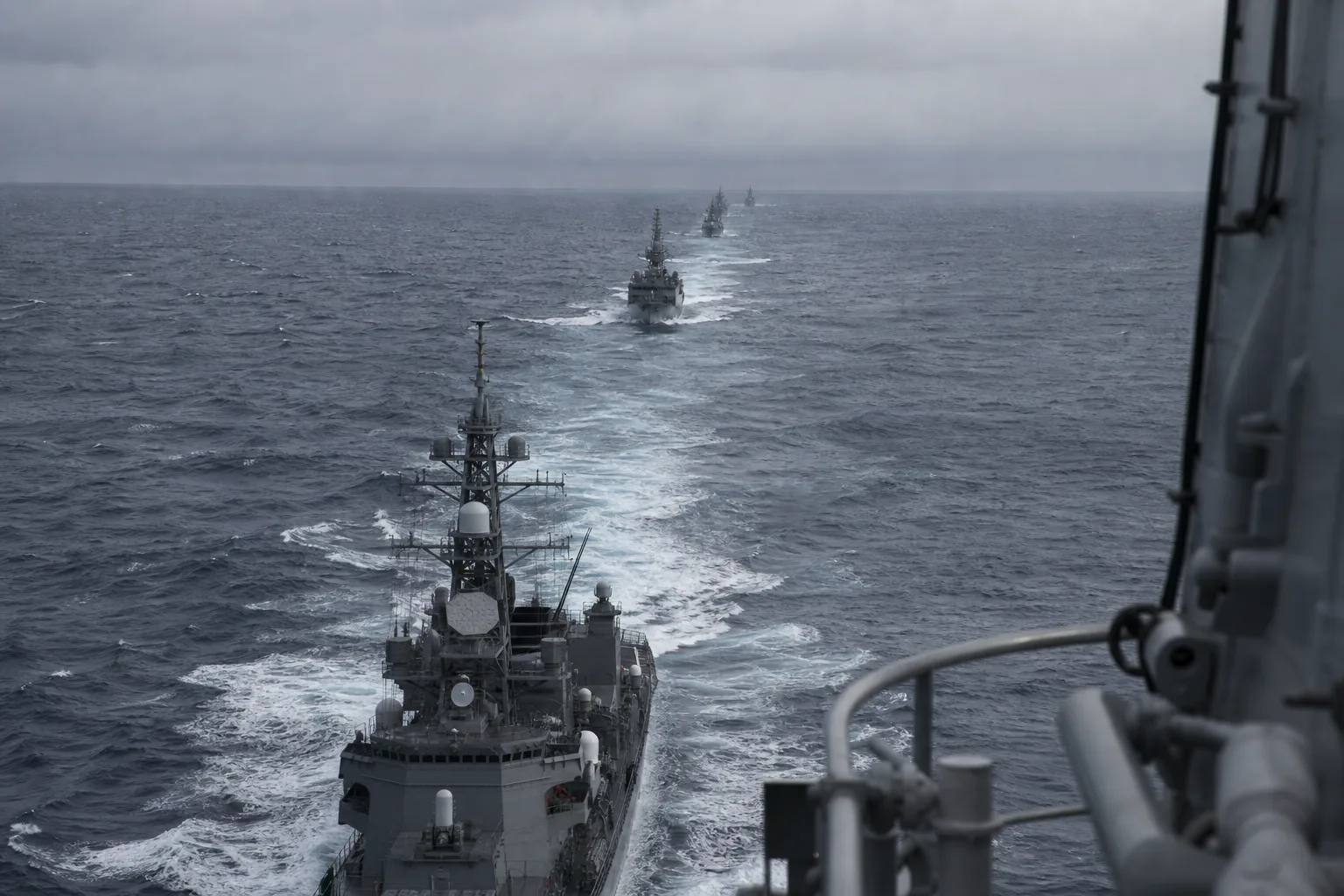
Ships and submarines
Warships and Submarines: Carriers, Destroyers and the Submarine Force
A navy is not a list of hulls. It is a set of groups that can be sustained at distance for months, and the ships that do the sustaining rarely appear in the photographs.
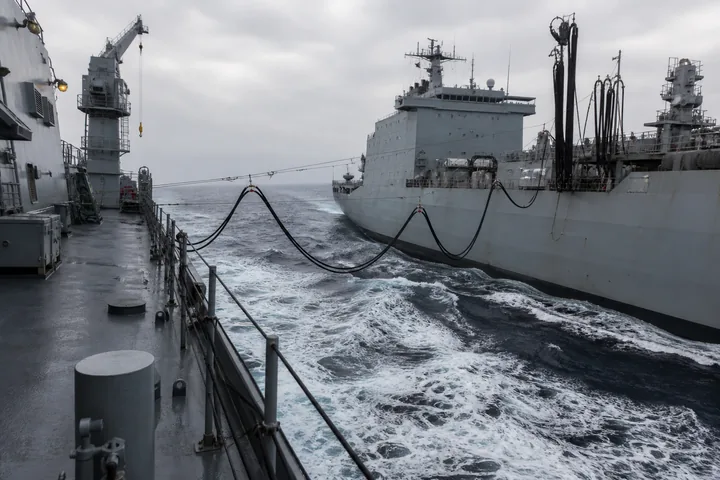
Naval power is measured in presence over time, not in tonnage. A ship in port contributes nothing; a ship on station contributes for as long as it can be fuelled, fed, repaired and crewed. This is why replenishment ships, tenders and maintenance capacity matter as much as combatants, and why a smaller fleet with strong logistics can hold a sea area longer than a larger fleet without it.
The second organising fact is that ships operate in groups. Air defence is layered across several hulls; anti-submarine warfare needs helicopters, towed arrays and often a friendly submarine; strike depends on the magazine capacity of the whole group. A single warship is a capability only in peacetime tasks.
Detection decides everything below the surface
Submarine warfare is a contest of who hears whom first, and the advantage compounds: the boat that detects without being detected chooses the engagement or declines it. That is why submarine design is dominated by acoustic quieting, why crews rehearse silent routine, and why the capabilities of any nation's submarine force are among the least publicly discussed parts of its military.
On the surface the equivalent contest is over sensors and reach. A surface group's usable striking distance is set by how far it can see and target, which increasingly means how well it is networked to aircraft, satellites and other ships and not what its own radar can do.
Classes
Seven classes- 01 Aircraft carriers Mobile airfields. The air wing is the weapon; the ship exists to operate it.
- 02 Guided-missile destroyers The workhorse surface combatant: air defence, strike and anti-submarine work.
- 03 Cruisers Larger magazines and air-defence command, a shrinking class in most navies.
- 04 Amphibious ships Move a Marine force with its vehicles, aircraft and landing craft.
- 05 Attack submarines Hunt other submarines and surface ships, and gather intelligence unseen.
- 06 Ballistic-missile submarines The most survivable leg of the nuclear triad, on deterrent patrol.
- 07 Logistics and replenishment Fuel, ammunition and stores at sea. Without them a fleet has weeks, not months.
Amphibious capability is a separate discipline
Putting a ground force ashore from the sea is not simply transport. It requires ships designed to carry vehicles and land them, well decks or landing craft to move them across the beach, flight decks for the aviation element, and command facilities to run the operation. The Marine expeditionary unit and the amphibious ready group that carries it are planned as a single package.
What that package buys is the ability to arrive without permission. No host nation has to agree, no airfield has to be available, and the force can loiter offshore for weeks while a decision is taken. That was the argument in Beirut in 1982 and it has been the argument in every amphibious deployment since, including the part where the force ashore remains dependent on the ships for everything it consumes.
A ship's availability is the number that governs everything else about it. A hull in a yard for a scheduled overhaul is not deployable, and a delayed overhaul removes it from the pool for longer than the delay itself, because the maintenance schedule behind it slips too. That is why a fleet total describes capacity poorly: the same number of hulls can support very different levels of presence depending on how much of the force is in maintenance, in work-up and at sea at any moment, and the ratio between those three states is set years in advance by the maintenance plan instead of by any operational decision.
Profiles
2 in the index- The Nuclear Aircraft Carrier: What a Flight Deck Actually Requires A carrier is not a ship with aircraft on it. It is a floating airbase whose deck cycle, fuel, ordnance and repair capacity determine everything it can do.
- The Nuclear Attack Submarine: Why Quiet Is the Capability A submarine's usefulness is a function of not being detected. Every design decision, and most of the cost, follows from that single requirement.
Accounts
Questions and answers
Why are carriers still built if missiles can reach them?
Because the alternative to a mobile airfield is a fixed one, which also can be hit and cannot move. The argument is not whether a carrier is vulnerable but whether it can operate far enough out, with enough warning and enough escort, to launch aircraft that reach the target. That is a question about sensors, escorts, air-wing range and tanking, and it is genuinely contested.
What does a strike group actually consist of?
A carrier with its embarked air wing, several guided-missile destroyers and often a cruiser providing layered air defence and strike capacity, and usually an attached submarine. Replenishment ships support it. The group is the unit of account because none of those elements is survivable or sustainable alone.
Why is submarine quieting so important?
Because detection is the whole contest. A submarine that is not detected chooses when and whether to engage; one that is detected is being hunted. Everything from hull form and propulsor design to machinery mounting and crew procedure serves the single goal of radiating less noise than the other side can hear.
What limits how long a fleet can stay on station?
Replenishment, crew endurance and maintenance cycles, in that order. Nuclear propulsion removes the fuel limit for the ship itself but not for its aircraft, and not for food, spare parts or ordnance. A deployment length is a logistics calculation with a hull attached.