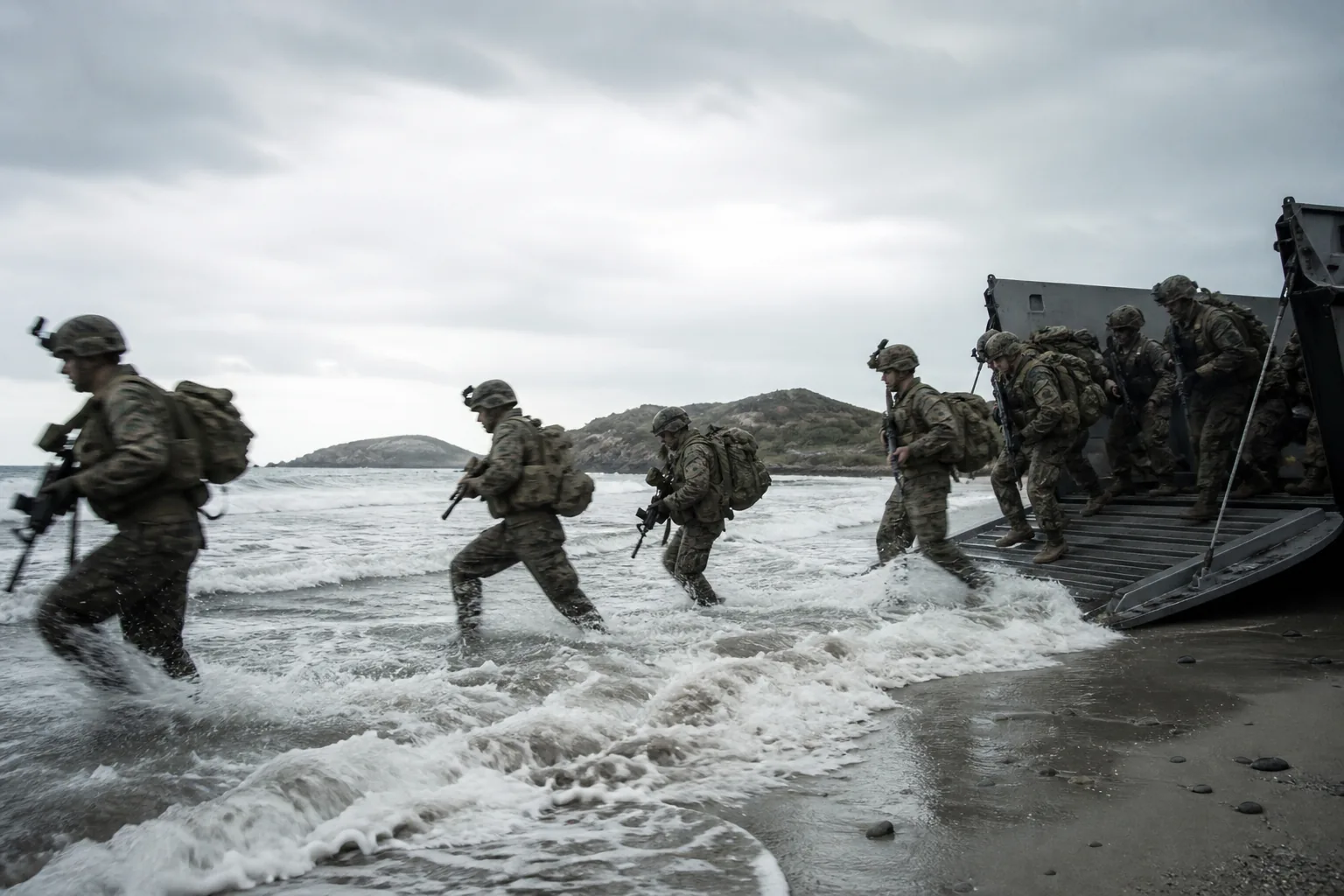
Marine Corps
The United States Marine Corps: Organised to Arrive, Not to Occupy
Built around the air-ground task force: infantry, aviation and logistics under one commander, carried by the Navy and able to arrive uninvited.
The Marine Corps exists to solve a specific problem: putting a capable, self-contained force ashore from the sea, quickly, in a place where the United States has no base and no standing permission. Its organisation, its training pipeline and its equipment choices all follow from that single requirement, and most of what looks unusual about the Corps makes sense once it is read against it.
The air-ground task force
Every other American service organises by domain. The Marine Corps organises by task. The Marine air-ground task force (MAGTF) is a single formation containing four elements under one commander:
- a command element, which is the headquarters and its enablers;
- a ground combat element, built around infantry with attached armour, artillery and engineers;
- an aviation combat element, with the task force’s own fixed-wing, rotary-wing and tiltrotor aircraft;
- a logistics combat element, carrying the supply, maintenance, medical and engineering support the force needs to operate without a base.
The point of the structure is that the commander does not have to ask anyone for the capabilities he needs. Air support is his. Logistics are his. He can plan an operation as one problem as opposed to as a set of requests to other headquarters.
The MAGTF scales. The same four elements build a Marine expeditionary unit of a few thousand, a Marine expeditionary brigade, or a Marine expeditionary force numbering tens of thousands. What changes is the size of each element, not the relationship between them.
One unit exists precisely because that self-sufficiency stops at the edge of the task force. An Air Naval Gunfire Liaison Company, ANGLICO, is a liaison and fire-support unit whose job is to plan, coordinate and conduct terminal control of fires for joint, allied and coalition forces operating alongside the MAGTF. It is a deliberate exception to the usual arrangement: ANGLICO is not designed to support Marine manoeuvre elements, which have their own controllers, but the units next to them that do not. The capability it supplies is the ability to call Marine aviation and naval gunfire accurately, which is not a thing an adjacent army brigade otherwise has.
Why the Navy carries it
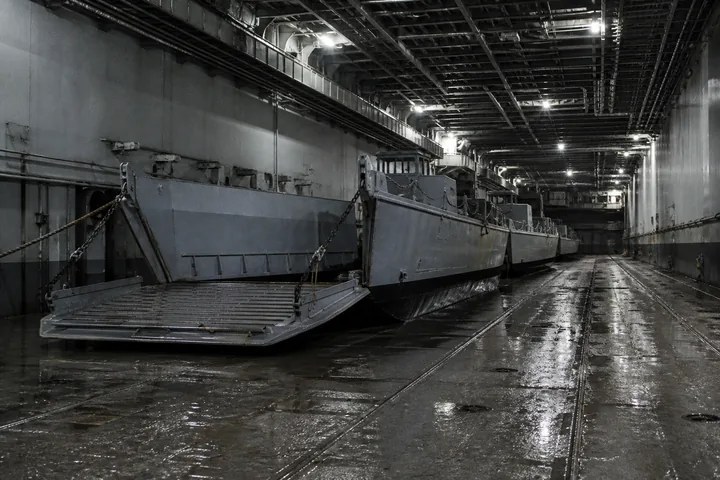
Amphibious capability is the Corps’ reason for existing and it is not something the Corps owns. The ships belong to the Navy: amphibious assault ships with flight decks, transport docks with well decks for landing craft, and the landing craft themselves. A Marine expeditionary unit deploys aboard an amphibious ready group, typically three ships, and lives aboard them for months.
That dependency cuts both ways. The Marines cannot go anywhere the Navy cannot take them, and the force ashore consumes everything the ships carry. But in exchange the United States gets a force that can loiter off a coast in international waters for weeks while a decision is taken, and that can go ashore without a host nation agreeing to anything. Nothing based on land offers that.
Aviation the Corps flies itself
Marine aviation is unusual in scope for a force of its size, and it is unusual because of the MAGTF logic. The Corps operates attack and utility helicopters, heavy-lift helicopters, tiltrotors, tankers, and fixed-wing strike aircraft: a substantial part of the latter being short take-off and vertical landing types specifically so they can work from amphibious ship decks and from short expedient strips ashore.
The trade is real: STOVL capability costs weight, complexity and maintenance hours. The Corps accepts it because basing freedom is the whole argument. An aircraft that needs a long runway needs a country willing to provide one.
Training and identity
Recruit training is the part of the Corps most visible to outsiders and the part it treats as most consequential. Recruits train at one of two depots (Parris Island or San Diego) for a period longer than the equivalent in the other services, and the stated objective is transformation instead of instruction.
Job training comes afterwards. Every Marine, whatever their eventual occupational field, first completes recruit training and then combat training designed to make them employable as infantry. The doctrine behind that is straightforward and is repeated constantly inside the institution: the Corps expects any Marine to be able to fight, because an expeditionary force ashore does not have spare people.
What the Corps has been arguing about
The Corps has spent recent years deliberately restructuring away from the equipment set it used in Iraq and Afghanistan, divesting heavy armour and some artillery in favour of lighter, dispersed units with long-range anti-ship and air-defence capability, intended to operate inside contested maritime terrain rather than to fight sustained land campaigns.
The change is genuinely contested inside and outside the service, and the argument is worth understanding because it is a clear case of a force choosing which future war to prepare for. The critics argue the Corps is discarding general-purpose capability that has repeatedly been needed on short notice. The advocates argue that a second land army is not what the country lacks. Both positions rest on predictions, which is why neither can be settled in advance.
Where to go next
- The US Navy The fleet, naval aviation and the submarine force.
- Ships and submarines What each class of warship is for at sea.
- Military careers How to join, what qualifies you, and what the first year looks like.
- Comparisons Branch against branch, path against path, system against system.
- The 2007 proposal to move the Marine Corps to Afghanistan One service, one theatre: the case made for it and why it went nowhere.
Questions and answers
Is the Marine Corps part of the Navy?
It is a separate armed service within the Department of the Navy. That means it has its own commandant, its own budget line and its own doctrine, while depending on the Navy for the ships that carry it, for much of its medical support, and for chaplains. Marines are not sailors and the services are not merged, but they are administratively joined.
What is a MAGTF?
A Marine air-ground task force: a single commander with ground combat, aviation, logistics and a command element all under him. It is scalable: the same idea builds a unit of a couple of thousand Marines or an expeditionary force of tens of thousands, and it is the organising principle of everything the Corps does.
Why does the Marine Corps operate its own aircraft?
Because the air element is part of the task force rather than a supporting agency. A MAGTF commander controls his own fixed-wing, rotary-wing and tiltrotor aviation, which means air support is planned inside the ground scheme of manoeuvre rather than requested from another service. Short take-off and vertical landing aircraft exist largely to make that work from ships and short strips.
How does Marine recruit training differ from the Army's?
It is longer, conducted at two depots and not many posts, and organised around a single identity outcome before any job training begins. Every Marine, regardless of eventual occupational field, completes recruit training and then combat training as an infantry-capable Marine before moving on to the school for their specialty.
What is a Marine expeditionary unit?
The standard forward-deployed MAGTF: an infantry battalion reinforced with armour, artillery and engineers, a composite aviation squadron, and a logistics battalion, carried by an amphibious ready group of three ships. It is sized to be useful on arrival and to sustain itself for a limited period without a base ashore.