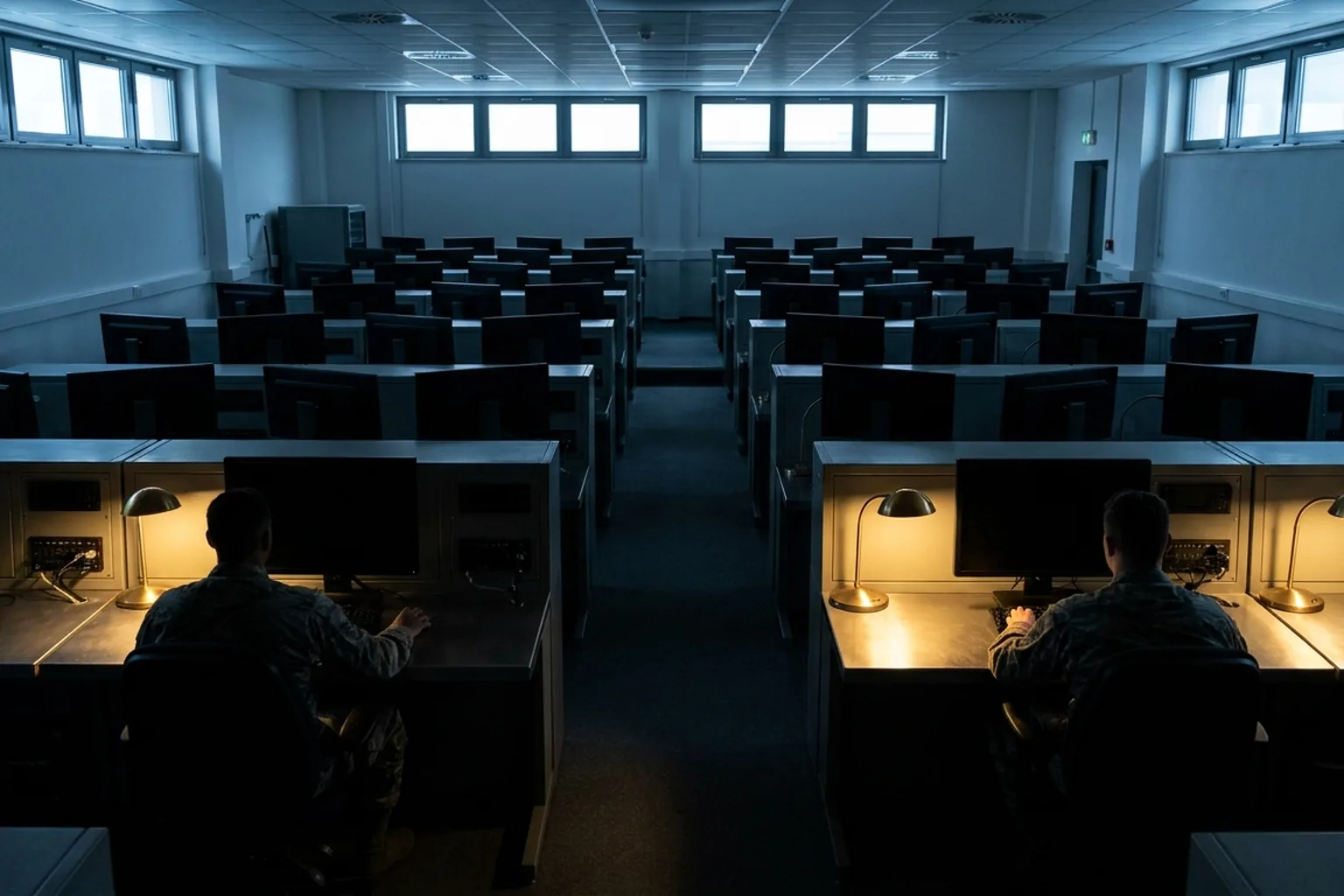
Cyber and spectrum
Cyber and Electromagnetic Warfare, Who Runs It and What It Does
Cyber and electromagnetic operations are the least visible military activity and among the most constrained. Both act on the same adversary systems, from different directions, under authorities held well above the tactical level.
Two distinct disciplines are usually discussed as one. Electromagnetic warfare acts on transmissions: jamming a radio net, deceiving a radar, denying a satellite navigation frequency over an area. Cyberspace operations act on the systems and data behind those transmissions. They are planned together because a commander wanting to blind an air-defence network does not much care which of the two achieves it, and because the same units increasingly hold both skill sets.
What distinguishes both from other military activity is the authority structure. A rifle company commander decides when to fire. The authority to conduct an offensive cyberspace operation is held far higher, frequently at national level, because effects can propagate beyond the intended target and because the operation may reveal a capability that took years to build. This is why cyber effects appear rarely and late in public accounts of operations.
Defence is most of the work
The great majority of military cyber effort is defensive and unglamorous: hardening networks, patching, monitoring, incident response, and protecting the logistics and personnel systems that an adversary would attack first because they are softer than weapons systems and just as necessary. A force that cannot move fuel does not need its networks attacked twice.
Weapons-system security has become part of this. Aircraft, ships and vehicles are now networked computing platforms, which means their software supply chains and maintenance interfaces are attack surfaces, and that securing them is a sustainment problem as much as a cyber one.
Areas of activity
Six areas- 01 Defensive cyberspace operations Protecting military networks, weapons systems and logistics data.
- 02 Offensive cyberspace operations Effects against an adversary network, authorised at national level.
- 03 Electromagnetic warfare Jamming, deception and protection across the radio spectrum.
- 04 Signals intelligence Collecting and exploiting adversary emissions and communications.
- 05 Network operations Building and running the communications the force depends on.
- 06 Career fields The 17-series cyber and 25-series signal military occupational specialties.
Emission control is the tactical half
For units in the field the practical form of this discipline is emission control: transmitting as little as possible, for as short a time as possible, from positions that do not matter. A command post is found by its antennas long before it is found by observation, and direction-finding against a radio that transmits on a schedule is straightforward.
The same logic now applies to personal devices, vehicle telematics and commercial navigation receivers, all of which emit and none of which were designed with concealment in mind. Managing that is a discipline problem instead of an equipment problem, and it is taught as one.
Why capability here is measured in access, not tools
Discussion of this domain tends to focus on tools, because tools can be named. The operationally scarce resource is access: a position inside a network, or on the path to it, that has been established quietly and can be relied on later. Access takes time to build, is easily lost, and is spent when used: an operation that works loudly usually destroys the access that made it possible. That trade-off, rather than the sophistication of any particular technique, is what constrains what gets attempted.
It follows that the most consequential activity in this area is not the disruptive kind but the patient kind: mapping networks, collecting credentials, maintaining a foothold across software updates. Effects operations are the visible minority and are frequently the least valuable use of a position. This is also why attribution is slow and contested — the same access can be used for collection or for disruption, and the technical traces of the two look similar from outside.
The organisational consequence is that these units are shaped more like intelligence organisations than like combat arms: small teams, long timelines, extreme compartmentalisation, and a promotion and retention problem caused by the fact that the same skills are worth more commercially.
Questions and answers
Is cyber warfare a separate service?
No. In the United States it is a functional combatant command drawing forces from every service, with each service generating and presenting cyber units to it. The Army does this through its cyber branch and the 17-series occupational specialties; the other services have equivalents.
How does electromagnetic warfare differ from cyber?
Electromagnetic warfare acts on the signal: jamming a radio, deceiving a radar, denying a navigation frequency. Cyber operations act on the system behind the signal, on data and software. They are planned together because they often target the same adversary capability from different directions, and the same unit may do both.
Why is spectrum management a combat function?
Because everything on a modern battlefield transmits (radios, data links, radars, drones, navigation receivers), and the spectrum is finite. Friendly systems interfere with each other before the enemy does anything. Deconflicting that is a planning task with direct tactical consequences, and it is also how a force controls its own detectability.