Unmanned systems
Military Drones: Reconnaissance, Armed Systems and Loitering Munitions
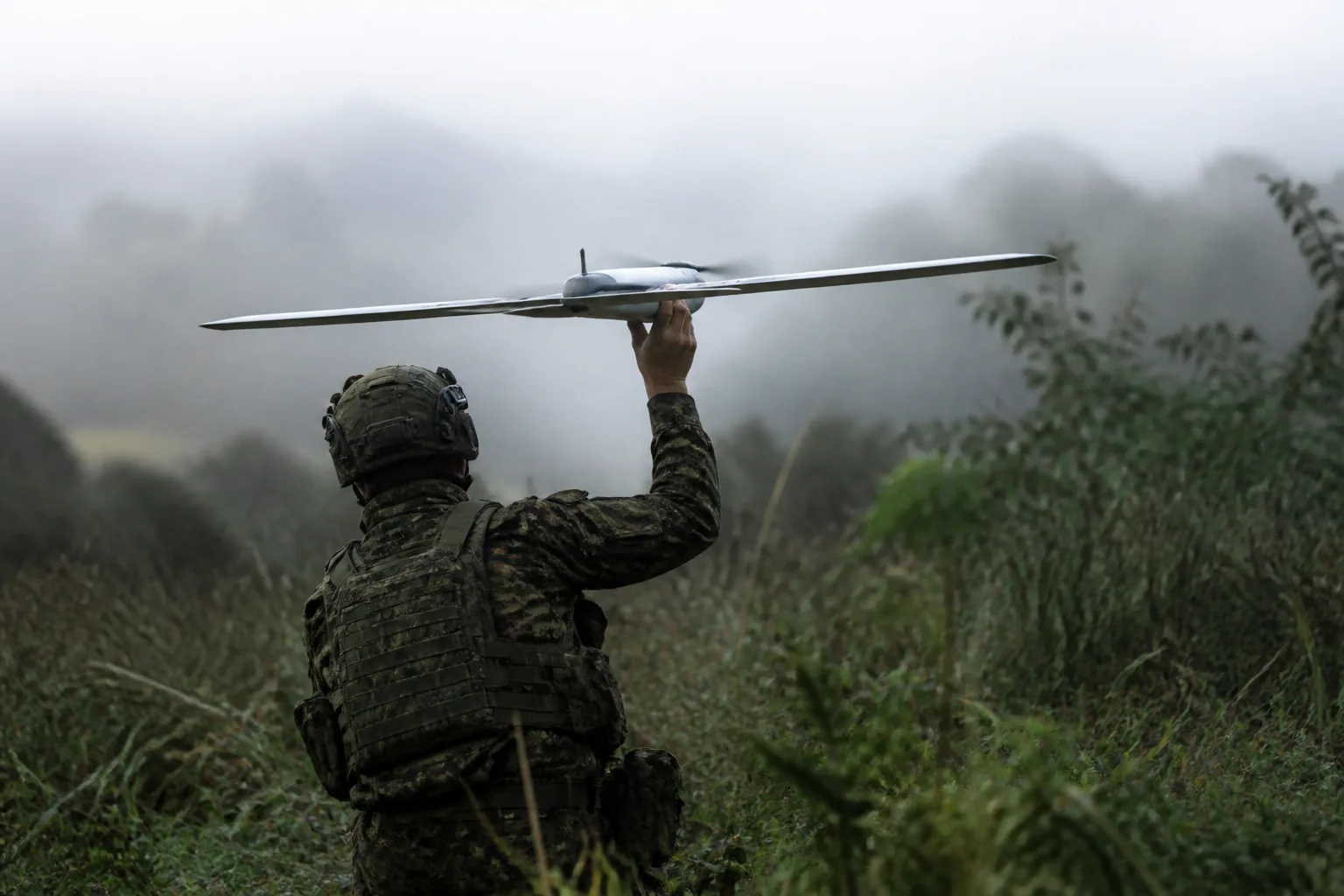
Unmanned aircraft cover a range wider than any other equipment category: from something a soldier throws by hand to an airframe with the wingspan of an airliner. Grouping them by size and altitude is the only way the category makes sense.
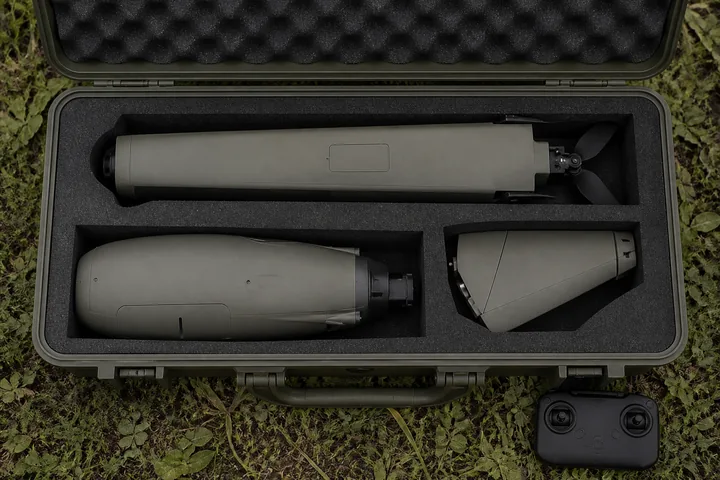
The word covers too much. At one end sits a battery-powered aircraft a soldier carries in a rucksack, flies for twenty minutes and uses to look over a wall. At the other sits a high-altitude airframe operating for a day at a time above most weather, feeding imagery to analysts on another continent. They share a name and almost nothing else, not the crew, not the command relationship, not the budget line.
Militaries therefore classify unmanned aircraft by weight, operating altitude and speed rather than by role. The practical value of the grouping is that it maps onto who owns the asset: the smallest systems belong to the squad or platoon that flies them, the middle groups belong to battalion and brigade, and the largest are theatre assets allocated by a joint headquarters.
What changed recently
For two decades the defining unmanned capability was persistent surveillance by a small number of expensive airframes over airspace nobody contested. That is no longer the interesting case. What has changed the character of ground fighting is the arrival of very large numbers of very cheap aircraft, flown by the units that need them, together with expendable loitering munitions in the same size class.
The consequence is that concealment has become much harder and much more important. Movement in daylight, vehicle concentrations, command posts with visible antennas and repeated use of the same route are all now easier to detect than they were, which pushes dispersion, camouflage discipline and emission control back to the centre of tactics.
Groups and roles
Six classes- 01 Hand-launched reconnaissance Carried by a squad, flown for minutes, answering what is over the next ridge.
- 02 Tactical unmanned aircraft Battalion and brigade assets, hours of endurance, catapult or runway launch.
- 03 Medium-altitude long-endurance Day-long surveillance and armed overwatch from a satellite link.
- 04 High-altitude long-endurance Theatre-wide surveillance from above most weather and most air defence.
- 05 Loitering munitions Search and strike in one expendable airframe. Not reusable, not a missile.
- 06 Counter-drone systems Detecting, jamming and shooting down the same category of aircraft.
The link is the weak point
Almost every unmanned aircraft depends on a radio link: to its operator, to a satellite, or to a navigation constellation. That dependency is the main vulnerability and the main avenue of defence. Jamming the control link, spoofing or denying satellite navigation, and locating the operator by direction-finding all attack the system without touching the airframe.
The counter to that counter is autonomy: an aircraft that can navigate without satellite positioning and complete a task after losing its link. This is where the current development effort sits, and it raises questions about targeting authority that are being argued out now as opposed to settled.
Counter-drone work is therefore layered in the same way as air defence: detect, identify, then choose the cheapest effective response — electronic where possible, kinetic where not. Getting the cost exchange right is the whole discipline.
The other constraint that shapes unmanned operations is the control link. A system flown from a distant ground station depends on satellite bandwidth that is finite and contested, and the response to jamming has been greater onboard autonomy instead of a stronger link. That is the direction current development runs in, and it changes what the aircraft is: less a remotely piloted vehicle, more a system given a task and left to complete it.
Profiles
1 in the indexQuestions and answers
What is the difference between a drone and a loitering munition?
Recovery. A reconnaissance or armed drone is flown, landed and used again; a loitering munition is expended on its target. The airframes can look similar and the control equipment can be the same, but they are budgeted, stocked and employed like ammunition instead of like aircraft.
Why are cheap drones such a problem for expensive equipment?
Because the exchange rate is wrong. Intercepting a few-thousand-dollar airframe with a missile costing several hundred times more is unsustainable even when it works, and the drone attacks the thinnest surfaces of an armoured vehicle from above. The responses that scale are electronic (jamming the link or the navigation signal) plus guns, nets and screens rather than missiles.
Are drones pilotless?
They are uninhabited, not unmanned. A medium-altitude armed system typically occupies a crew of at least a pilot and a sensor operator, plus intelligence analysts exploiting the feed and a launch-and-recovery team at the airfield. Crew requirements per airframe are often comparable to a manned aircraft; what changes is that nobody is in the aircraft.
Do drones need airspace control?
Very much so. A crowded low-altitude band shared by helicopters, artillery trajectories and dozens of small unmanned aircraft is a deconfliction problem before it is a technology problem, and it is one of the harder staff tasks in current operations.