Space Force
Space Force: Organisation, Mission and What Keeps Changing
Established in 2019, the Space Force is the only American service still visibly deciding what its own field organisation should look like.
Coverage of the Space Force tends to divide between novelty and dismissal, and both miss the interesting part. The service exists because a mission set (satellite communications, positioning and timing, missile warning, space domain awareness) grew large enough and distinct enough that running it inside an aviation service stopped making sense. The parallel with 1947, when the Air Force separated from the Army, is exact enough to be worth stating.
What makes it worth following now is that it is the only service still openly working out its own structure. Its formations are Deltas: organised around a mission and not a location, which was a deliberate departure from the wing model it inherited, and the arrangement has been revised more than once since establishment.
Why reorganisation is a personnel story
Field organisation determines which units exist, what each owns, and therefore what assignments exist and how someone progresses through them. A service that reorganises around missions instead of installations is also rewriting its career paths, and that is the part that affects the people in it rather than the diagram.
Related reading
Why space coverage is harder to read than it looks
Space is the domain where the gap between what is announced and what is verifiable is widest. Most capability sits in systems whose performance is classified, operated by units whose activity is not published, and procured through programmes whose costs are reported in aggregate. What remains visible is launches, contracts, organisational changes and budget lines: the paperwork around the capability and not the capability itself.
That shapes what can honestly be said. A launch confirms that something reached orbit, not what it does there. A contract award confirms that money has been committed, not that the system will work or arrive on schedule. A reorganisation confirms that someone believed the previous structure was wrong. Each is real information, and none of it supports the confident capability claims that usually get attached to it.
Three things that are genuinely diagnostic
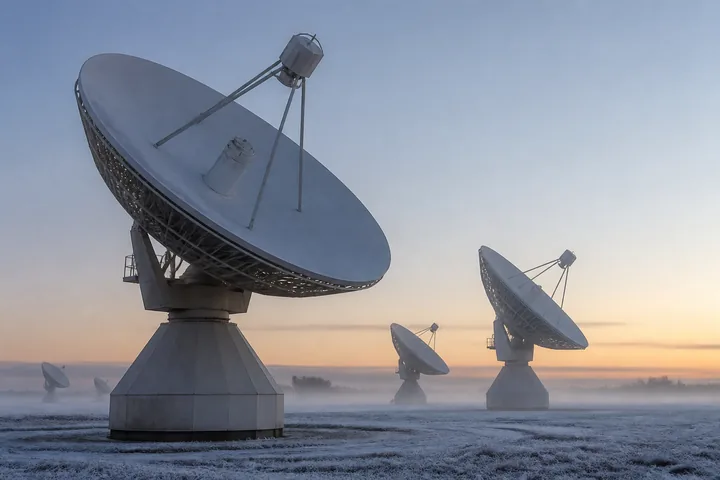
Orbital mechanics constrain everything and cannot be spun: an orbit's altitude and inclination tell you what a satellite can see and how often, and those are observable from the ground by anyone who cares to track it. Second, ground segment matters as much as the spacecraft — antennas, operations centres and the people to run them are expensive, visible, and a constellation without them is inert. Third, replacement rate: a capability that cannot be replenished on the timescale of a conflict is a peacetime capability, however good it is.
Where these pages describe organisation, they draw on what the service itself publishes about its structure. Where they describe capability, they stay with what the physics and the public record will support, and they say when a claim rests on an announcement rather than on a demonstration.
One further asymmetry is worth keeping in view when reading any comparison of national space capability. Launch capacity and satellite count are published and get compared; the ability to task, process and distribute what those satellites collect is not, and it is the part that turns collection into something a unit can use. A country can hold an impressive constellation and little of the analytical and communications machinery behind it, and from outside the two look identical on a chart.
The practical reading rule that follows: treat an announcement as evidence about intent and budget, and wait for a demonstration before treating it as evidence about capability. The two are separated by years more often than not, and the gap is where most confident claims about this domain go wrong.
Questions and answers
Why is the Space Force reorganising its Deltas?
Because its field organisation is still settling. The service inherited a wing-and-squadron model from the Air Force and has been deliberately moving away from it toward formations built around missions and not installations: a missile-warning Delta covers a global constellation, so organising it around the base it sits on adds nothing.
What does that mean for people in the service?
Assignment paths follow organisation. Reorganising around missions and not geography changes which units exist, what they own and how someone progresses through them, which is why field reorganisation is a personnel story as much as a structural one.
Is the Space Force growing?
Its budget has grown substantially faster than its headcount, because its costs are dominated by systems, not people. It remains by a wide margin the smallest armed service, and it is likely to stay small in personnel terms while acquiring more capability.