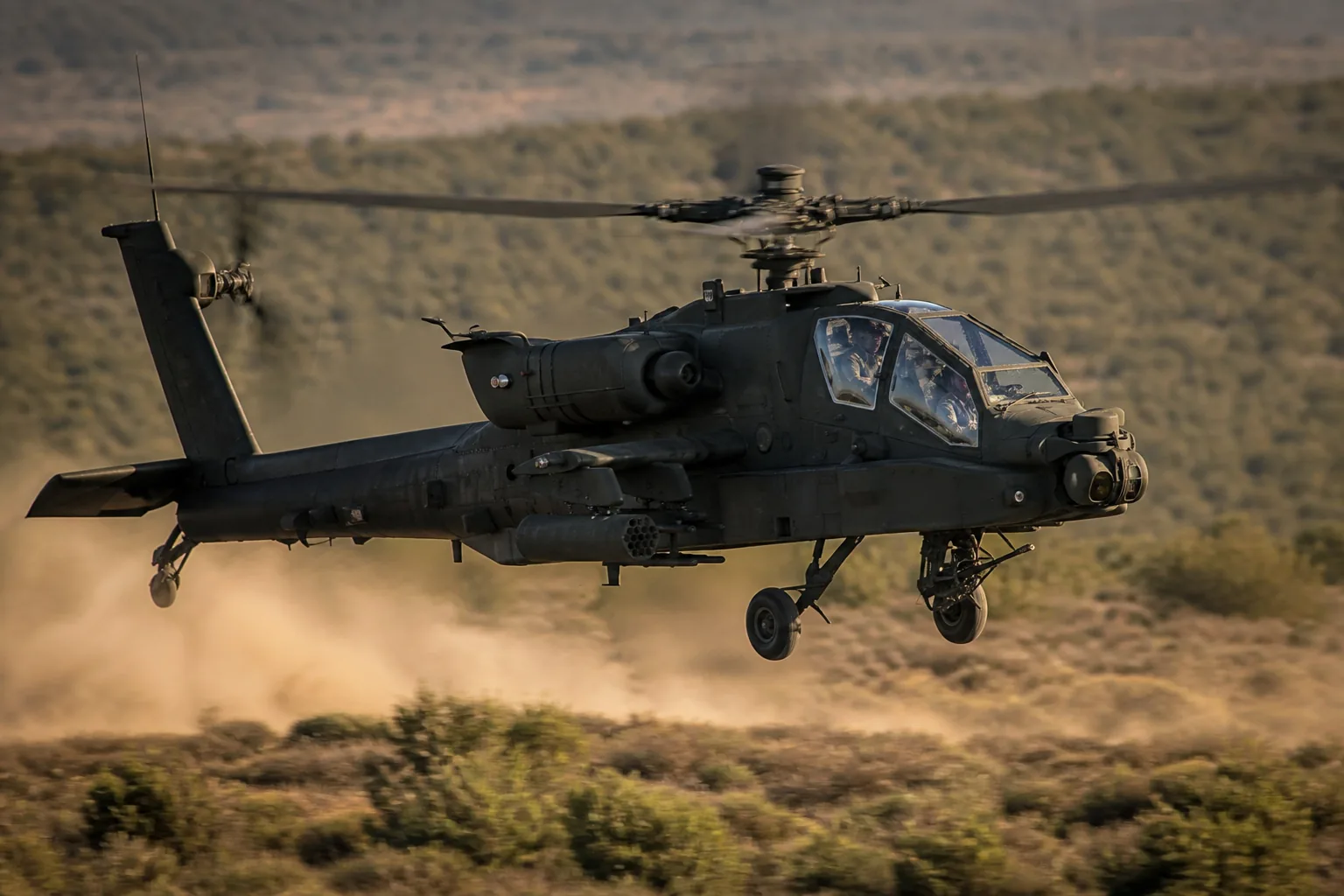
Helicopters
Military Helicopters: Why Vertical Lift Is Worth Its Vulnerability
A helicopter is the only aircraft that can deliver people and cargo to a precise point on the ground without a runway. Everything difficult about rotary-wing aviation follows from paying for that ability.
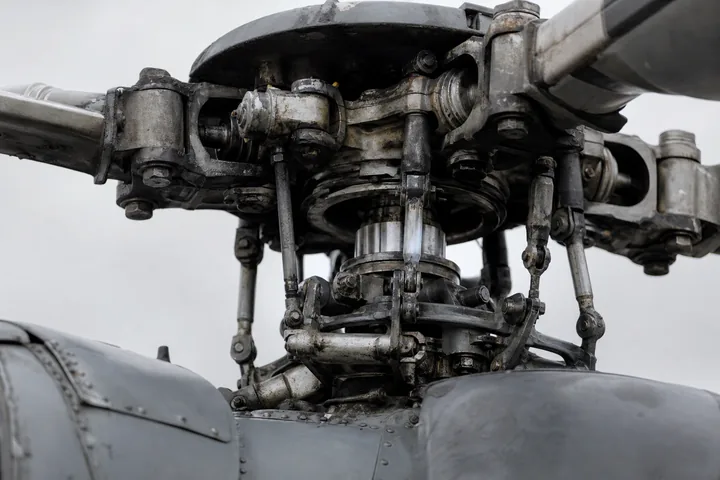
Rotary-wing aviation exists to solve a problem fixed-wing aircraft cannot touch: putting a load down at a chosen point, on unprepared ground, and picking one up again. That capability is why helicopters remain central to ground operations despite being slower, shorter-ranged, more maintenance-hungry and far more exposed than aeroplanes.
The exposure is real and it is not diminishing. A helicopter operates in the band of airspace where small arms, heavy machine guns and shoulder-launched missiles all reach, and it cannot accelerate away. Rotary-wing tactics are therefore built around not being seen and not being predictable: flying low enough to use terrain as cover, moving at night, approaching a landing zone from an unexpected direction, and keeping time on the ground to a minimum.
The number that governs planning
Helicopter performance is dominated by air density. Lift depends on the mass of air the rotor can move, and hot, thin air at altitude offers less of it. The practical effect is that a mission planner does not work from a published maximum payload but from a calculated figure for the day's pressure altitude and temperature. High-altitude operations in summer can cut usable payload dramatically, which is why the same fleet performs very differently in different theatres.
Maintenance is the second governing constraint. A rotor system is a set of parts under constant cyclic load, inspected and replaced on strict schedules. Flight hours accumulate against those schedules quickly, and the ratio of maintenance hours to flight hours is high enough that availability, not inventory, is what a commander actually has.
Roles
Six classes- 01 Attack helicopters Armed reconnaissance and anti-armour work, operating with ground manoeuvre units.
- 02 Assault and utility Moving infantry squads, casualties and supplies over short distances.
- 03 Heavy lift Artillery, vehicles and slung loads too heavy for utility types.
- 04 Naval rotary-wing Anti-submarine warfare, plane guard and vertical replenishment from ship decks.
- 05 Special operations Long-range infiltration at night and at low level, heavily modified airframes.
- 06 Tiltrotor Aeroplane cruise speed with vertical landing, at the cost of complexity.
Working with ground units
Attack helicopters are not close air support in a different airframe. They are usually employed as part of the ground commander's own scheme of manoeuvre, cued by and talking directly to the units they support, and they can hold a position, observe and then engage in a way a fast jet passing overhead cannot.
Assault aviation is planned as an air assault operation rather than a taxi service: the landing zone is selected and confirmed, suppression is arranged, the lift is sequenced so that the first aircraft in are not left alone, and an extraction plan exists before the first aircraft launches. When air assaults go wrong it is normally the landing zone, not the aircraft, that was the problem.
Medical evacuation deserves separate mention because it drives airframe numbers and basing more than its share of flight hours suggests. The expectation that a casualty can reach surgical care within a short window shapes where aircraft sit and how many are held ready rather than tasked.
Rotary-wing availability behaves differently from fixed-wing availability, and the reason is maintenance hours per flight hour. A helicopter accumulates them faster than an aircraft of comparable cost, which is why a squadron's flying programme is planned around maintenance capacity, not around aircraft count, and why a deployment that increases flying hours reduces the number of airframes available a few months later.
Lift also falls with altitude and temperature, which is why a load that is routine at sea level in winter is not routine in summer at height.
Profiles
2 in the index- The AH-64 Apache: An Aircraft Designed to Be Shot At Attack helicopters operate within range of what they are attacking. Almost every feature of this one follows from accepting that instead of avoiding it.
- The UH-60 Black Hawk: The Aircraft That Ends Up Doing Everything The least glamorous aircraft in an army and the one whose absence is felt fastest, because medical evacuation is its most consequential job.
Questions and answers
Why are helicopters so vulnerable, and why are they used anyway?
They fly low and slow within reach of everything from rifles to man-portable air defence missiles, and they cannot outrun a threat. They are used anyway because nothing else puts a squad, a howitzer or a casualty exactly where it needs to be without a runway. The answer to the vulnerability is tactical (terrain masking, night, speed of transit, suppression of the landing zone), not technical.
What limits how much a helicopter can lift?
Air density, mostly. Lift falls as altitude and temperature rise, so the same airframe that carries a full load at sea level on a cold morning may carry a fraction of it from a mountain landing zone in the afternoon. Planners work in terms of what the aircraft can lift under the day’s conditions, not what the specification says.
How does a tiltrotor differ in practice?
It roughly doubles cruise speed and greatly extends range compared with a conventional helicopter of similar size, which changes what a single aircraft can reach in a night. The cost is mechanical complexity, downwash strong enough to constrain landing sites, and a maintenance burden that is higher per flight hour.