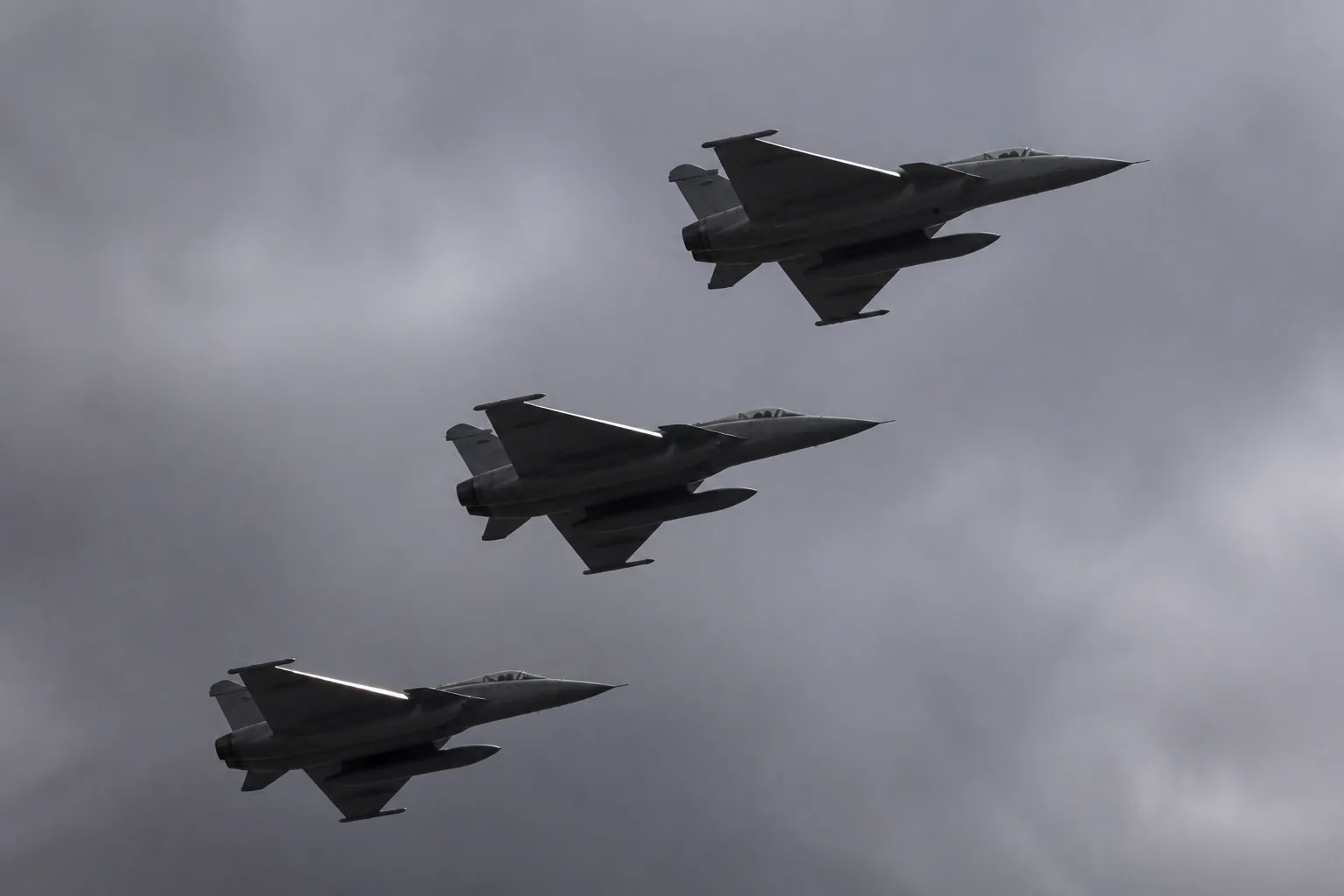
Aircraft
Military Aircraft: Fighters, Bombers, Tankers and Surveillance
Aircraft are grouped by role rather than by looks, because role decides everything else: how far the aircraft flies, what it carries, how survivable it needs to be, and how many of it a service can afford.
Air power is easy to describe and hard to generate. The aircraft is the visible part; the capability is the aircraft plus the crews, the bases or decks it operates from, the fuel and munitions moved to those bases, the maintenance depth behind the flight line, and the tankers that extend its reach. Change any one of those and the capability changes, even if the aircraft inventory does not.
The roles below are stable across air forces because they follow from physics and geography rather than from doctrine. An aircraft optimised to fly high and fast will not loiter. One optimised to loiter will not survive contested airspace. One optimised for range will be large, which makes it expensive and few in number. Every fleet is a compromise between these, and the shape of the compromise tells you what the service expects to be asked to do.
Why fleet composition is the interesting number
A service with a small number of very capable aircraft and a large tanker fleet is built for reach. One with many cheaper aircraft and little refuelling capacity is built for defence close to home. Neither is wrong; they answer different questions. Reading a fleet list as a ranking misses this entirely: the informative comparison is between a fleet and the distances it is expected to cover.
Roles
Eight classes- 01 Air superiority fighters Built to defeat other aircraft and hold airspace. Range and sensor reach matter more than payload.
- 02 Multirole fighters Air-to-air and air-to-ground in one airframe. Most of any modern fighter fleet is multirole.
- 03 Bombers Long range, large payload, no expectation of dogfighting. The fleet is small and individually significant.
- 04 Close air support Slow, survivable, long loiter, working directly with ground units.
- 05 Tankers Air refuelling. Every long-range mission is a tanker mission first.
- 06 Airlift Strategic and tactical transport, including airdrop and austere-field landing.
- 07 Surveillance and command Airborne early warning, ground surveillance radar and airborne command posts.
- 08 Maritime patrol Anti-submarine warfare, surface search and long-endurance ocean surveillance.
Carrier aviation is a different problem
An aircraft designed to operate from a carrier deck pays for it throughout the airframe. It needs strengthened landing gear and a tailhook for arrested recovery, structure able to take catapult loads, folding wings to fit the hangar and the deck park, and corrosion protection for years at sea. Those requirements add weight, and weight costs range and payload.
In exchange the aircraft can operate from anywhere the ship can reach, without host-nation permission, basing agreements or a runway. That is the whole argument for carrier aviation, and it is why the composition of a carrier air wing is a good indicator of where naval aviation thinks the next decade is going: the mix of fighters, electronic-attack aircraft, airborne early warning and unmanned tankers reflects a judgement about what the ship will have to fight.
The Marine Corps solves the same problem differently, using short take-off and vertical landing aircraft that can work from amphibious ships and from short expedient strips ashore. The trade there is again weight and complexity, bought for basing freedom.
One number explains more about an air force than any inventory total: how many hours it can afford to fly. Aircrew proficiency is perishable, currency requirements are specific, and flying hours are the budget line that absorbs pressure first when other costs rise. A fleet that exists but flies less is a fleet with less capability, and the fall is quiet because the aircraft are still there to count.
Profiles
2 in the index- The F-22 Raptor: Built for One Job, and Built Before Its Time An air superiority fighter designed in the Cold War and delivered afterwards, in a number too small to be routine and too capable to be replaced.
- The F-35 Lightning II: What the Design Actually Optimises For Judged as a dogfighter it looks compromised. Judged as a sensor and networking platform that happens to carry weapons, the design decisions become legible.
Accounts
Questions and answers
What does a generation number actually mean?
It is a loose classification, not a standard. Fourth generation broadly means a supersonic multirole fighter with a digital cockpit and beyond-visual-range missiles. Fifth generation adds low observability designed in from the airframe up plus sensor fusion. The labels are useful shorthand and are also used as marketing, so they should not be treated as measurements.
Why do tankers matter so much?
Because combat radius without refuelling is far shorter than the distances involved in most operations. Tanker availability, not fighter numbers, frequently sets how many aircraft can reach a target area and how long they can stay. Tanker fleets are old, expensive to replace and rarely discussed outside the services that depend on them.
Is stealth the same as invisibility?
No. Low observability reduces the range at which a radar of a given type can detect and track an aircraft. It shifts the engagement geometry in the pilot’s favour instead of removing the aircraft from the picture, it works better against some radar bands than others, and it depends on maintaining surface coatings and keeping weapons carried internally.
Why is close air support still flown by dedicated aircraft?
Because the mission rewards qualities that fast jets trade away: long loiter over the same patch of ground, the ability to work below cloud, tolerance for ground fire, and a gun sized for the job. Multirole fighters can and do fly the mission, but they burn fuel faster and cannot stay as long.