Ships
The Nuclear Aircraft Carrier: What a Flight Deck Actually Requires
A carrier is usually described by what it carries. The more useful description is what it has to do continuously: launch and recover aircraft, refuel and rearm them, repair them, and keep several thousand people fed and rested while doing it, for months, without stopping.
The deck is the constraint
The number of aircraft aboard is the least informative figure about a carrier. What determines its output is the deck cycle.
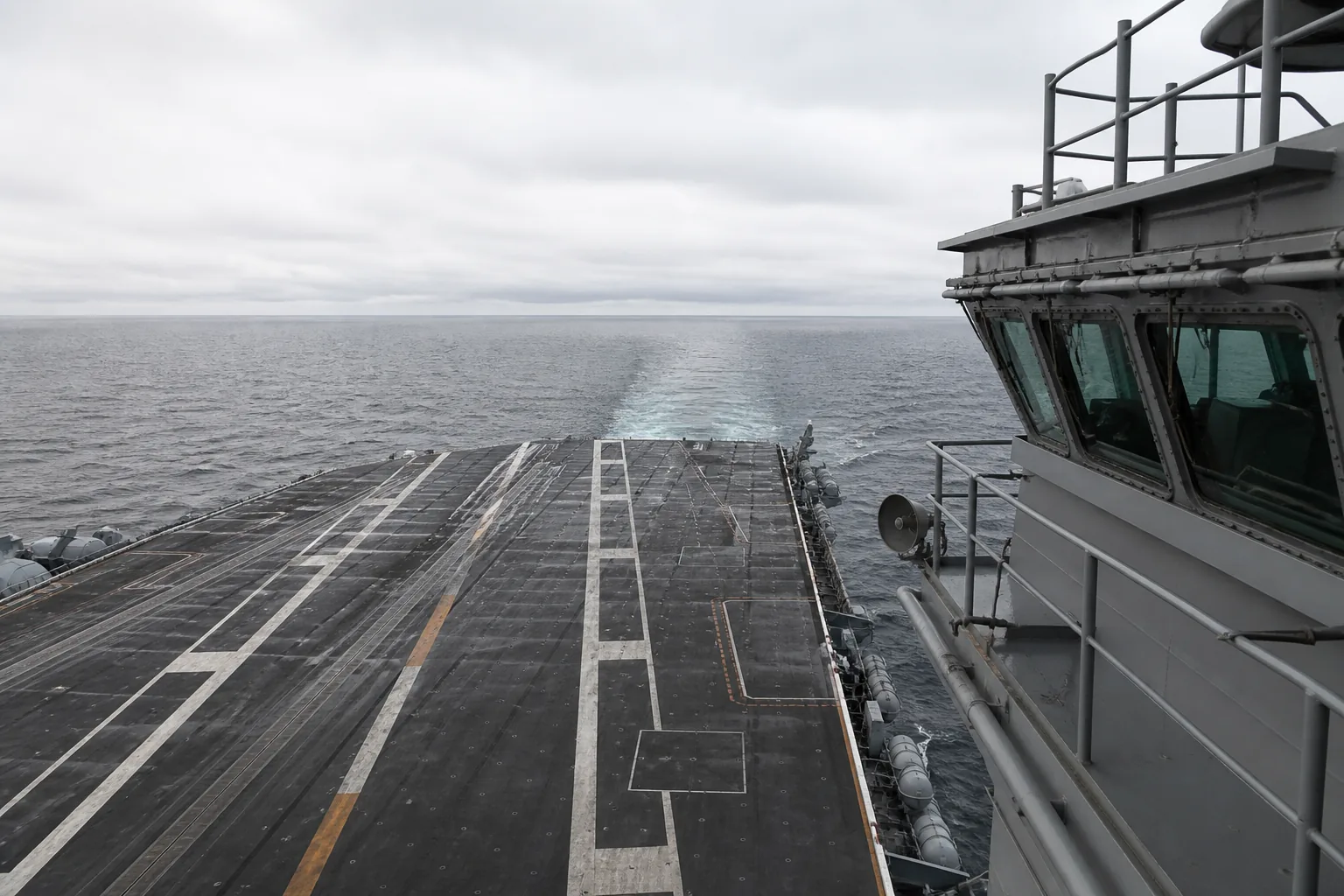
Every aircraft that launches must be brought to a catapult, aligned, connected and released. Every one that returns must be caught by arresting gear, cleared from the landing area before the next arrives, and moved to a parking spot. In between, aircraft must be refuelled, rearmed, inspected and sometimes repaired, on a surface that is also the runway.
That is a scheduling problem with hard physical limits, and it (not the inventory) sets how many sorties a carrier can generate per day and for how many consecutive days. Crew endurance, ordnance handling rates and deck space are the binding factors.
What nuclear propulsion does and does not solve
It removes the ship’s own fuel from the logistics equation. The carrier can run at high speed for extended periods without refuelling, and its endurance is limited by what the people and the aircraft consume and not by the hull.
It does not make the ship independent. Aviation fuel, ordnance, food and spare parts are consumed at high rates and must be delivered at sea, which is why underway replenishment remains as essential for a nuclear carrier as for any other ship. The replenishment force is part of the carrier’s capability, not an accessory to it.
Why it never operates alone
The carrier’s defensive capability is modest relative to the weapons directed at it, and its value makes it the primary target in any maritime conflict.
So it operates as a strike group: surface combatants providing air and missile defence with their own sensors and vertical launch capacity, submarines providing undersea protection, and the whole formation sharing one integrated air picture.
This is why counting carriers overstates available capability. A carrier without escorts cannot be committed, and escort availability is governed by the same maintenance queue as everything else in the fleet. The escorts are the constraint on how many carriers can actually deploy.
The argument about the future
Long-range anti-ship weapons have made operating a very large surface ship within their reach more dangerous and more expensive, and the argument that this makes carriers obsolete is serious.
The counter-argument is mobility. A carrier can reposition hundreds of miles in a day, which makes it a substantially harder targeting problem than a fixed airbase, and no alternative currently provides comparable sustained air power at sea.
What is not disputed is the direction of the response: greater emphasis on standoff weapons so aircraft can strike without the ship closing, on dispersal, and on making the group harder to locate. The capability is being adapted rather than abandoned, and whether the adaptation is sufficient is the actual question.
Everything above is why a carrier is discussed as a schedule rather than as a ship. Deployment, maintenance and workup occupy fixed and unequal stretches of time, so the number in commission is never the number available, and the gap between the two is the figure that actually constrains planning. A carrier promised to two theatres at once is a carrier in neither for the months it spends moving between them. Extending a deployment borrows against the next one, and the debt is repaid in a longer yard period, so the schedule absorbs pressure for a while and then stops absorbing it all at once.
Questions and answers
Why does a carrier need escorts?
Because the carrier itself has limited defensive capability relative to the threats directed at it, and because its value makes it the primary target in any maritime conflict. Escorting surface combatants provide air and missile defence, submarines provide undersea protection, and the group operates as one integrated system. A carrier without escorts is not a reduced capability; it is a liability.
What does nuclear propulsion actually change?
It removes the ship's own fuel from the logistics equation, so the carrier can operate at high speed for extended periods without refuelling and its endurance is set by what the crew and the air wing consume rather than by the hull. Aviation fuel, ordnance, food and spares still have to be delivered, which is why underway replenishment remains essential even for a nuclear ship.
How many aircraft can it actually generate?
Fewer than a count of embarked aircraft suggests, because the constraint is the deck cycle as opposed to the inventory. Launching, recovering, refuelling, rearming and moving aircraft on a finite deck is a scheduling problem, and sortie generation depends on crew endurance, deck space, ordnance handling and maintenance as opposed to on how many airframes are aboard.
Are carriers obsolete against long-range missiles?
It is a serious argument and it is not settled. Long-range anti-ship weapons genuinely raise the cost and risk of operating a large surface ship within their reach, which has pushed thinking toward greater standoff, dispersal and deception. The counter-argument is that a mobile airbase that can be repositioned hundreds of miles a day is a harder target than a fixed one, and that no alternative provides comparable sustained air power at sea.