Submarines
The Nuclear Attack Submarine: Why Quiet Is the Capability
Almost everything about a nuclear attack submarine follows from one requirement: not being detected. It is not one design goal among several. It is the capability, and speed, depth, weapons and sensors are useful only to a boat that has not been found.
Why detection is decisive
A located submarine has lost most of its value even if it is not attacked. Its position can be avoided, its approach can be anticipated, and the uncertainty that made it a threat is gone.
That asymmetry is what makes submarines strategically disproportionate. A small number of boats whose positions are unknown constrain an opponent’s behaviour across a large area, because the possibility has to be planned for everywhere. The same boats, tracked, constrain nothing.
What makes one quiet
There is no single feature, and that is the important point about the cost.
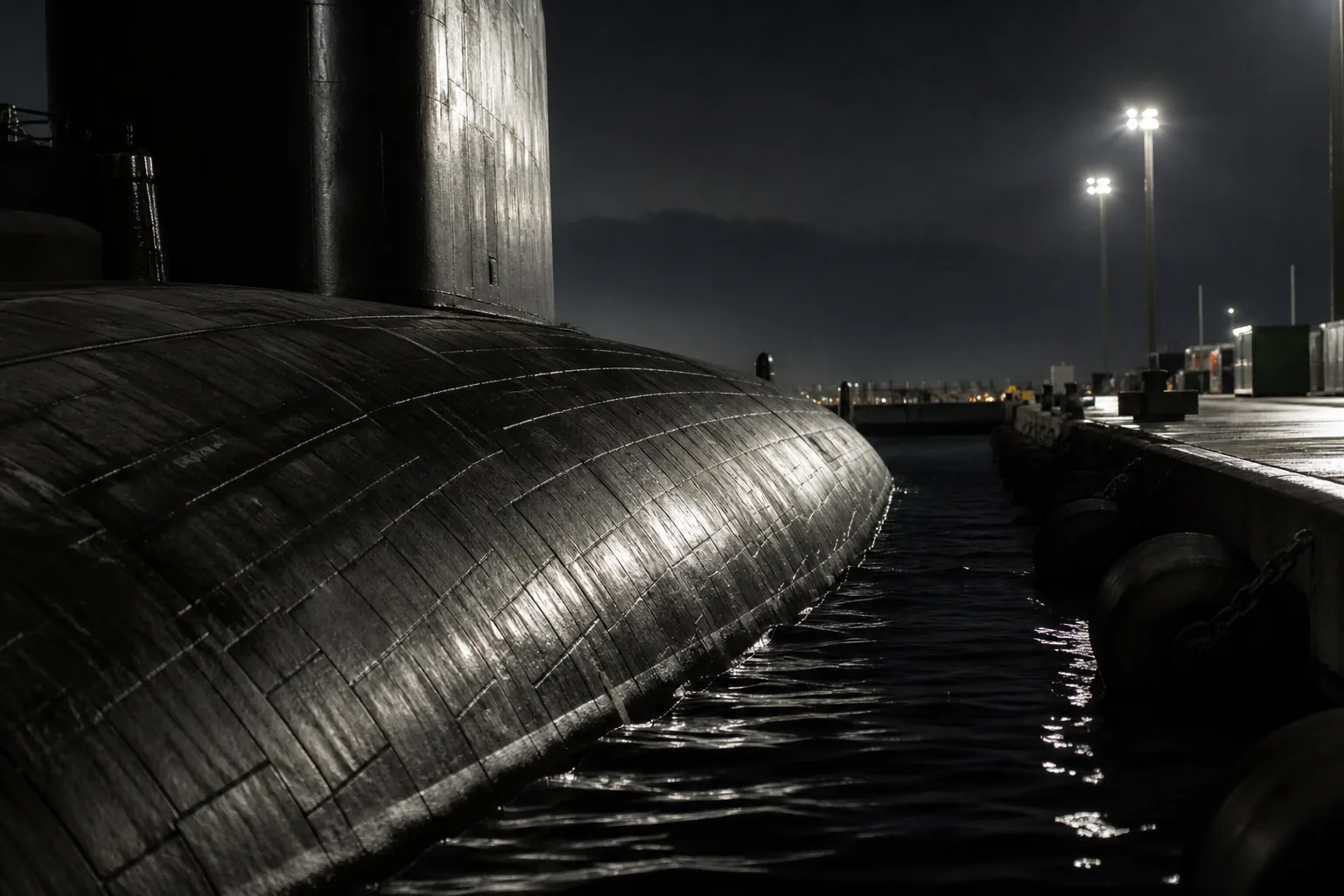
Machinery is mounted on isolating rafts so vibration does not transmit into the hull. Propulsors are designed to avoid cavitation — the collapse of bubbles that produces the loudest noise a submarine can make. Hull coatings absorb and scatter incoming sonar and dampen radiated sound. Pumps, hydraulics and ventilation are designed for smooth flow. Crew procedures avoid activities that make noise at the wrong moment.
Quiet is an accumulation of thousands of small engineering decisions applied consistently across an entire vessel, and it is the reason submarines cost what they do. There is no cheap version of this, because the cheapness would be audible.
What they actually spend their time doing
The name suggests attacking ships, and in peacetime the work is largely something else.
Intelligence collection and surveillance in waters where a surface ship cannot go unnoticed. Tracking other submarines, which is the hardest technical task in the domain. Land-attack strike with cruise missiles from positions an opponent cannot predict. Inserting and recovering special operations personnel. Anti-shipping capability held in reserve for a conflict.
The surveillance role is the one the people who task submarines value most, and it is the least visible.
Why the build rate is the real constraint
Submarine construction is limited by industrial capacity rather than by money alone.
The tolerances are extreme. Pressure hull and reactor work requires certified welders, specialised facilities and inspection regimes with no margin for error. The acoustic requirements mean a large share of components are bespoke instead of commercial. The number of yards and the number of qualified people capable of this work is small, and expanding either takes years.
The consequence is that a decision to build more submarines does not produce more submarines quickly. It produces a queue, and the queue is the reason submarine force levels are discussed in decades rather than in budget cycles.
A submarine’s usefulness is set by endurance rather than by speed. Nuclear propulsion removes the fuel limit for the boat itself, so the constraints that end a patrol are food, crew endurance and the maintenance cycle waiting at the other end of it.
Replenishment, crew endurance and the maintenance cycle are the three limits, in that order.
The same arithmetic shapes how the boats are used. A force whose size cannot be changed quickly is managed by deciding where not to send it, so the scarce resource is not the submarine but the decision about which task is worth a hull for the length of a patrol and the refit that follows. Presence in one ocean is absence in another, and that trade is made years before anyone notices the gap it leaves. The queue also removes the usual response to a shortfall: a surface force can be surged by shortening maintenance, and a submarine force cannot, because the maintenance is what keeps the reactor certified.
Questions and answers
Why does quietness matter more than speed or depth?
Because detection is the whole game. A submarine that is located can be attacked or simply avoided, and either outcome removes its value. Speed and depth are useful and neither substitutes for not being found, which is why acoustic signature reduction absorbs a large share of the design effort and the construction cost.
What makes a submarine quiet?
Mostly engineering discipline applied everywhere. Machinery mounted on isolating rafts so vibration does not reach the hull, propulsors designed to avoid cavitation, hull coatings that absorb and scatter sound, hydraulic and pumping systems designed to run smoothly, and operating procedures that avoid noise. There is no single feature; it is the accumulation of thousands of decisions, which is why it is expensive.
What does a nuclear attack submarine actually do?
Several things, most of them not attacking ships. Intelligence collection and surveillance in places surface ships cannot go. Tracking other submarines. Land-attack strike with cruise missiles. Special operations insertion. Anti-shipping in a conflict. The peacetime work is largely surveillance, and that is the capability most valued by the people who task them.
Why are they so expensive and slow to build?
Because the tolerances are extreme, the pressure hull and reactor work requires specialised facilities and certified welders, and the acoustic requirements mean almost every component is bespoke. The industrial base capable of that work is small, and its capacity (not the budget alone) sets the rate at which submarines can be produced.