Tanks
The M1 Abrams: The Turbine Decision and Its Consequences
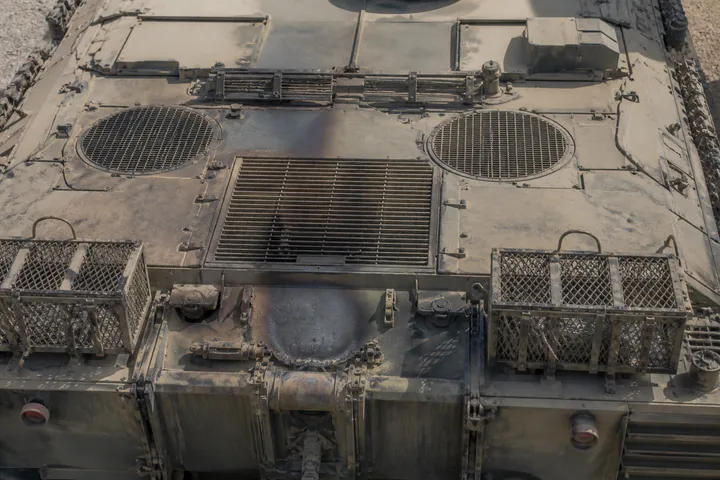
The M1 Abrams has been in service for over four decades and has been revised so thoroughly that a current vehicle shares little but its outline with the original. The design decision that has mattered most across that whole period is the one made first: the engine.
The turbine, and what it bought
The Abrams uses a gas turbine rather than a diesel. What that provides is a high power-to-weight ratio, very smooth acceleration for a sixty-tonne vehicle, quiet running at low speed, and the ability to run on a wide range of fuels, a real operational advantage when supplying a formation from whatever is available.
What it costs is fuel. Consumption is high under load and, unusually, high at idle as well, which matters because a tank in a defensive position spends a great deal of time stationary with the engine running to power its systems.
That consumption is not a specification detail. It determines how many fuel vehicles a formation needs, how often it must pause, and therefore how far it can operate from a supply point. For an army with a very large logistics organisation this is absorbable. It is the main reason the tank is a difficult proposition for a smaller one, and the main reason its export footprint is narrower than comparable designs.
What has changed, and what has not
The hull and turret outline are recognisably original. Almost everything else has been replaced.
The main gun was changed from a rifled weapon to a larger-calibre smoothbore. The armour array has been revised repeatedly, including the addition of applique packages for specific threats. Fire control, sights, thermal imaging, communications and crew displays have all been through more than one generation.
This is the normal life of a successful armoured vehicle, and it is worth stating because comparisons between tanks frequently compare a current variant of one against an earlier variant of another. The useful question about any tank in service is which variant, and against what threat.
Four crew and a human loader
The Abrams retains a human loader where several contemporaries adopted automatic loading systems. The trade is workload against mechanical complexity, and the design settled on the former.
The practical argument for the fourth crew member has little to do with loading rate. Four people means more hands for track maintenance, more eyes for observation, and the ability to maintain security while part of the crew rests — all of which matter more in sustained operations than the loading cycle does.
Armies that chose autoloaders made a defensible opposite trade, and both approaches remain in front-line service, which is the usual sign that neither is simply correct.
What operating it actually involves
For anyone considering the job that goes with this vehicle, the honest description is that most of it is maintenance. Track links and tension, road wheels, filters, fluids, optics, weapon systems: a tracked vehicle of that mass generates work continuously, and the consequence of falling behind is a vehicle that is not available.
Gunnery is the visible part and a small fraction of the hours. That is not a criticism of the design; it is what a sixty-tonne machine costs to keep in a condition where its capabilities are actually available.
Weight is the tank’s defining trade and it is paid off the battlefield. Bridges, transport aircraft, rail cars and port cranes all have limits, and a vehicle that exceeds them arrives late or not at all. Protection that cannot be delivered where it is needed is protection in the wrong place, which is why every increment of armour is argued about in terms of logistics rather than of survivability.
Questions and answers
Why a gas turbine instead of a diesel?
For power-to-weight, smooth acceleration, quiet running at low speed and tolerance of a wide range of fuels. The costs are fuel consumption, which is high in operation and remains high at idle, and a specialised maintenance profile. It was a reasonable choice for an army with a very large logistics organisation, and it is the reason the tank is a harder proposition for smaller armies.
How much has the design changed since 1980?
Substantially, across several major variants: the main gun was changed from a rifled to a smoothbore weapon of larger calibre, the armour array has been revised repeatedly, and the fire control, sights, communications and crew displays have been replaced more than once. The hull and turret shape are recognisably the original; almost nothing inside is.
Why does it still have a human loader?
Because the alternative (an automatic loading system) trades crew workload against mechanical complexity, and the design settled on four crew with a human loader. The practical benefit is a fourth body for maintenance, security and observation, which matters more in sustained operations than the loading cycle does. Armies that chose autoloaders made the opposite trade and both remain in service.
What does it require to keep running?
More than most people expect. Track links and tension, road wheels, filters, fluids, optics and weapon systems all generate continuous work, and the fuel demand requires a substantial tanker and fuel-handling organisation behind any formation operating it. A crew that falls behind on maintenance has a vehicle that will not be available when it is needed.