Armoured vehicles
The M2 Bradley: What an Infantry Fighting Vehicle Is Actually For
The Bradley is consistently misdescribed in both directions: as a light tank, which it is not, and as a troop truck, which it also is not. It is an infantry fighting vehicle, a category with a specific purpose, and the purpose explains the design.
The problem it solves
Infantry has to reach the objective. Walking there exposes it for a long time; riding in an unprotected vehicle exposes it differently; riding in a tank is not possible.
An infantry fighting vehicle carries a squad under armour at the speed of the armoured formation it moves with, puts them out at the objective, and then (this is the part that distinguishes it from a carrier) stays to support them with fire.
That last requirement is why the vehicle has a turret. A vehicle that delivers infantry and departs leaves the squad with less firepower than it had while mounted. An autocannon that can suppress a position, engage light armour and be directed by the squad it just delivered is the reason for the whole category.
Armour that protects against the right things
Its protection is designed against fragments, small arms and light cannon fire: the threats infantry faces in the open, at the moment of dismounting.
It is not designed against tank main armament, and this is the distinction that gets lost. A Bradley committed like a tank against prepared anti-armour defences is a large target with insufficient protection.
Doctrine therefore pairs it with tanks rather than substituting for them: tanks provide the protected firepower against armoured opposition, the Bradley brings and supports the infantry, and the infantry deals with the close terrain and the anti-armour teams that would otherwise kill the tanks. Each covers a weakness of the others.
The capacity problem
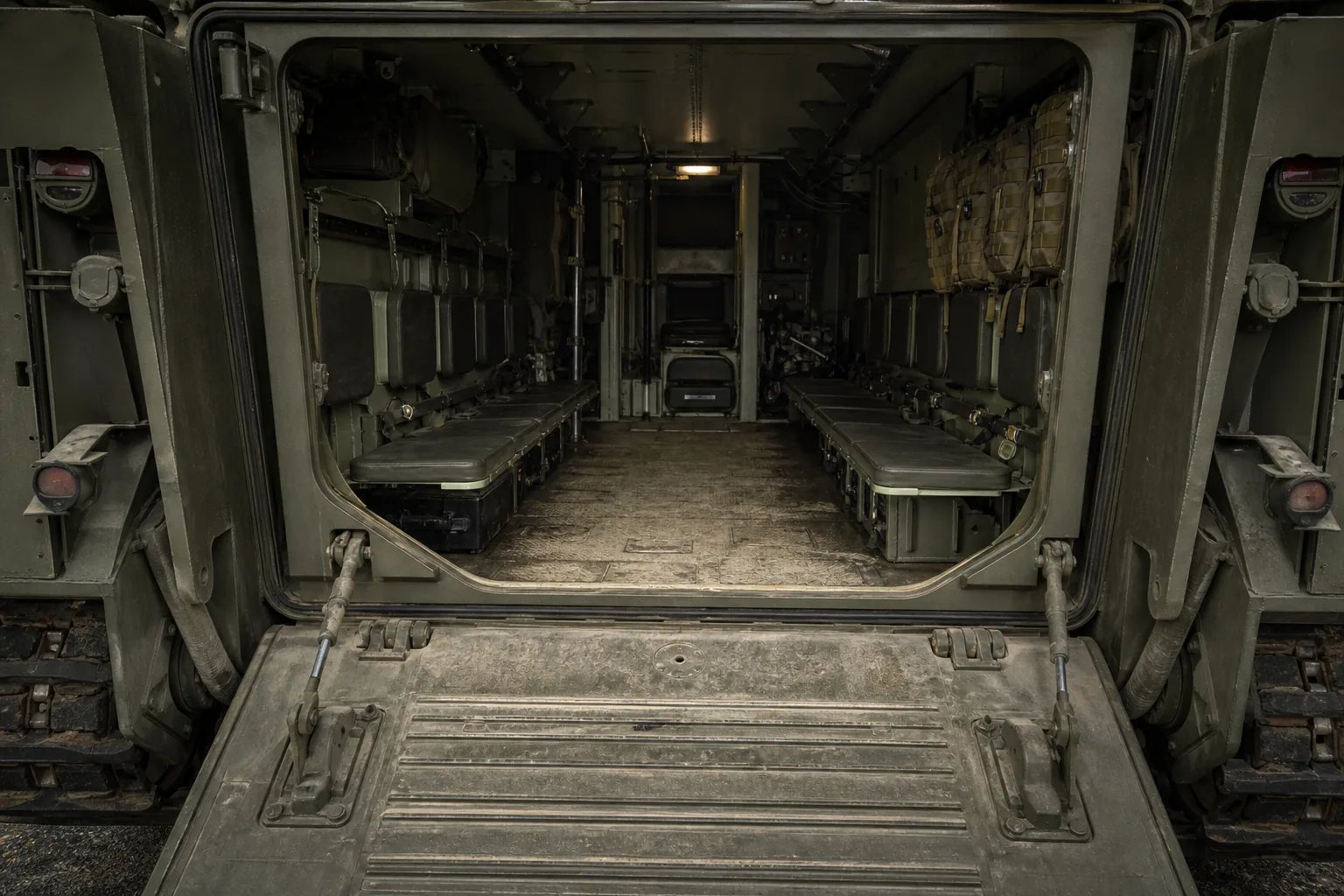
The vehicle carries fewer dismounts than the infantry squad it is intended to move, because internal volume went to the turret, the ammunition and the systems.
This has been a live tension since it entered service, and it is a genuine design cost, not an oversight — the volume had to come from somewhere, and every alternative sacrificed something else. Reconciling squad organisation with vehicle capacity is a practical problem for the units that operate it, and it is worth knowing about because it is the sort of constraint that never appears in a specification sheet.
Why it is still here
The fleet has been upgraded repeatedly: armour packages, optics, fire control, and substantial work on survivability against mines and roadside explosive devices after two decades of use in conflicts where those were the primary threat.
Several replacement programmes have been started and cancelled. That pattern is characteristic of a vehicle that is adequate rather than obsolete: the case for replacement is real, the cost of replacing a fleet of that size is very large, and an upgraded vehicle keeps being the cheaper answer for another few years.
The vehicle has been upgraded repeatedly, and the cumulative weight of that work is the reason it is still in service. Armour, optics, fire control and protection against mines and roadside devices have all been revised, each time adding mass that the powertrain then had to carry.
The vehicle’s awkward reputation follows from being asked to do two jobs whose requirements pull apart. Carrying infantry rewards volume and protection; fighting alongside tanks rewards a low profile and a gun. Any single design settles that argument somewhere, and the settlement is visible in every complaint made about it from either direction. The vehicle has been modified more or less continuously since, which is the usual fate of a compromise that works well enough to keep rather than well enough to leave alone.
Questions and answers
Why does an infantry carrier need a cannon and missiles?
Because a vehicle that only delivers infantry has to leave once they dismount, and the infantry then has less supporting fire than it started with. An autocannon lets the vehicle suppress positions, engage light armour and support the dismounted squad from a position where it can see the objective. The anti-armour missiles exist so it can defend itself and its infantry against tanks it cannot fight with the cannon.
Is it a light tank?
No, and using it as one is the recurring error. Its armour protects against fragments, small arms and light cannon fire, not against tank main armament. Committed like a tank against prepared anti-armour defences it is vulnerable, which is why doctrine pairs it with tanks instead of substituting it for them.
How many infantry does it carry?
Fewer than the squad it is meant to move, which is a real and well-documented design tension: internal volume was consumed by the turret, ammunition and systems. The practical consequence is that squad organisation and vehicle capacity have to be reconciled, and this has been a live issue since the vehicle entered service.
Why is it still in service after four decades?
Because it has been upgraded repeatedly (armour, optics, fire control, survivability against mines and roadside devices), and because replacing an entire fleet of that size is an enormous programme. Several replacement efforts have been started and cancelled, which is the usual pattern for vehicles that are adequate and not obsolete.