MOS 25B
25B Information Technology Specialist: Duties and Civilian Value
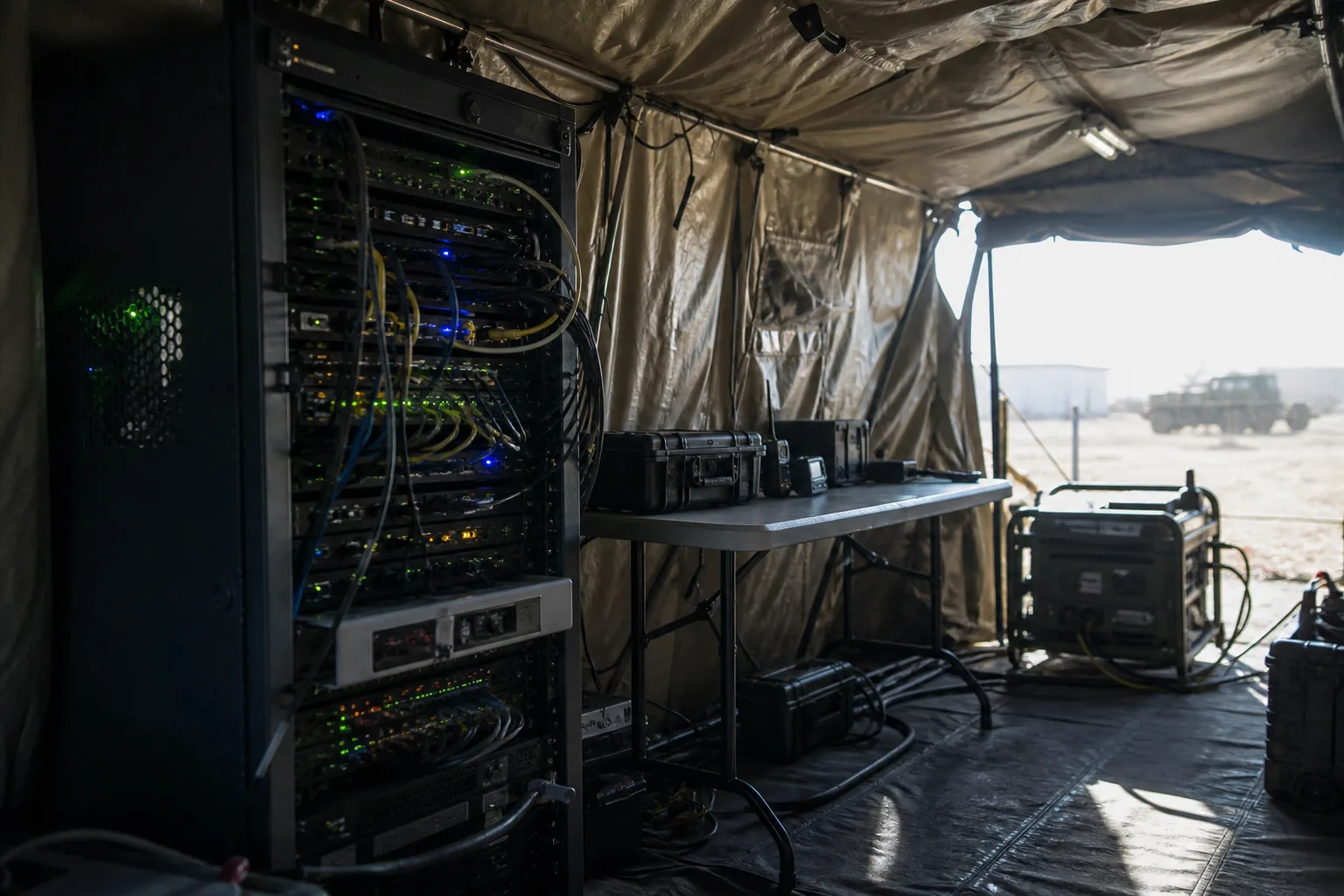
The 25B installs, configures, maintains and defends the networks and computer systems a unit runs on. In garrison that is recognisably an IT job. On deployment it is the same job performed on a generator, in a tent, for users whose operations stop when the network does.
What the work is
Building and operating the local network: servers, routers and switches, user accounts and permissions, the systems that carry command-and-control traffic and the mundane ones that carry email and file shares. Plus the daily reality of support: someone’s account is locked, a workstation will not connect, a printer is on the wrong subnet, which is the same everywhere.
The distinctively military parts are three. Setting up from nothing: a unit arrives somewhere with equipment in cases and needs a working network in hours. Operating under constraint: limited bandwidth over a satellite link, intermittent power, temperature and dust well outside equipment specifications. And defending it: military networks are attacked continuously, and the people who run them are the first line.
Training
Basic combat training followed by advanced individual training at the Army’s signal school in Georgia, covering networking fundamentals, the systems the Army fields, and the security requirements that govern working on its networks.
Because Defense Department policy requires certification for personnel working on its networks, 25Bs generally end up holding recognised commercial credentials. This is a substantial and often underestimated benefit: the certification is the same one a civilian employer asks for.
Where the career goes
Advancement runs from working on systems to running the section that works on systems, and then to managing a unit’s communications capability as a senior noncommissioned officer — at which point the job is planning, resourcing and supervising rather than configuring.
Lateral movement inside the 25-series is common: into transmission systems, into network management, into a specialised role. The 17-series cyber field is a separate path with its own selection and longer pipeline, and 25B is a recognised feeder into it for people who want offensive and defensive cyberspace operations, not infrastructure.
What it is worth afterwards
Among the most directly marketable Army specialties, for three reasons that compound: the technical content overlaps with civilian work, the certifications are the industry’s own, and a clearance opens cleared roles that pay a premium.
Network and systems administration is the obvious path. Cybersecurity operations recruits heavily from the field, particularly with an active clearance. Cloud and data-centre operations value the fundamentals.
The honest caveat is currency. Military networks include older equipment on long replacement cycles, so a soldier can leave with excellent fundamentals and limited exposure to the newest commercial tooling. That gap is closable with deliberate self-study during service, and the people who do it transition fastest.
What it is worth afterwards
This is one of the specialties whose civilian value transfers most directly, because the work is recognisable outside the institution and much of it carries a certification. What does not transfer automatically is the context: running a network under field conditions, with the power and the bandwidth you actually have, is a different job from running one in a building.
The civilian value of the training is real and narrower than it looks. What transfers is the discipline of running a network somebody else depends on, under conditions where the answer cannot be to reboot everything and see; what does not transfer automatically is any particular vendor’s certification, which has to be earned separately.
Civilian work this leads to
- Network and systems administration
- Help desk and IT support, moving into infrastructure roles
- Cybersecurity operations, especially with a clearance
- Cloud and data-centre operations
Questions and answers
Do you get civilian certifications?
Commonly yes. Department of Defense policy requires certification for people working on its networks, so 25Bs typically hold recognised commercial credentials in security and networking. Which ones vary with assignment and policy, and they carry real weight with civilian employers because they are the same certifications the industry uses.
How is this different from a civilian IT job?
The environment. You are building and maintaining a network in a tent or a vehicle, with power that may be a generator, in dust or cold, for users who cannot wait, sometimes while the unit is moving. The technical content overlaps heavily with civilian work; the conditions do not.
What is the difference between 25B and 17C?
25B builds and defends the Army's own networks. It is infrastructure and operations. 17C is a cyber operations specialist, in the offensive and defensive cyberspace mission under a different career field with its own selection and a longer, harder training pipeline.
Is a clearance required?
Yes, at least Secret, and higher for some assignments. As with any cleared field, the background investigation is a real gate and candour during it matters more than the underlying issues it examines.
Does the Army teach current technology?
Broadly yes, with a lag. Military networks run a mix of current and older equipment because replacement cycles are long and certification requirements are strict. Soldiers frequently gain unusually deep experience with fundamentals and less exposure to the newest commercial tooling, which is a reasonable trade for a career.