Wars
World War I: Why the Western Front Deadlocked, and What Broke It

World War I is remembered as a war of futile frontal attacks, which is accurate about a great many individual days and misleading about the whole. The deadlock on the Western Front was not the product of stupidity; it was the product of a genuine technical problem for which no army possessed a solution in 1914, and the four years that followed were substantially a search for one.
The problem, stated precisely
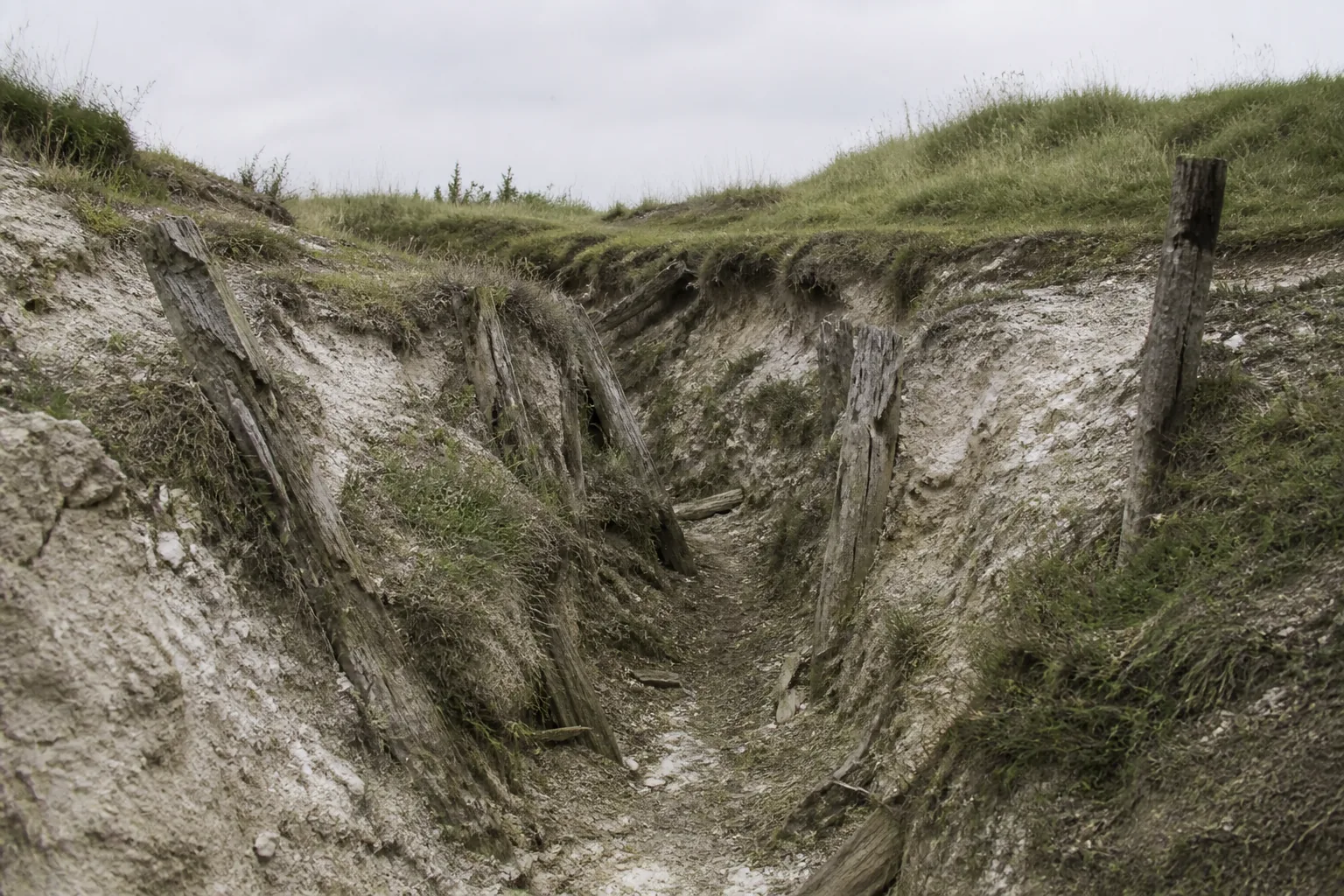
Three technologies arrived together and reinforced each other. Quick-firing artillery could put a large volume of shell onto a small area at ranges beyond direct observation. The machine gun let a handful of men cover a wide frontage with continuous fire. Barbed wire, cheap and quickly laid, did not itself kill anyone: it held attackers stationary within range of the weapons that did.
Against that combination, an attack could still succeed locally. What it could not do was continue. Artillery had to be moved forward over ground it had just destroyed, which took days. Telephone cable, the only reliable communication, was cut by shellfire the moment the attack began, so commanders lost contact with their own leading troops at the precise moment decisions mattered. The defender, meanwhile, moved reserves laterally by rail, faster than the attacker could advance across a churned battlefield.
The result was a structural asymmetry: local success at high cost, followed by a sealed breach. This held on every front where both sides were industrially capable and had the space to entrench.
Why the obvious answers did not work
More artillery. Longer and heavier bombardments destroyed the ground the attack had to cross, removed surprise entirely, and gave the defender days of warning to move reserves. The bombardment that guaranteed the break-in guaranteed the failure of the break-out.
More men. Additional troops on a frontage that could not be widened increased casualties without increasing the rate of advance. Density beyond a certain point made the attacker a better target.
Attacking elsewhere. Campaigns opened in other theatres in the hope of finding a flank. They produced their own difficulties (terrain, disease, distance, shipping) without relieving the central problem, and several were more costly per objective than the front they were meant to circumvent.
The synthesis that worked
By 1918 both sides had assembled a method, and it was cumulative and not sudden.
Artillery gained the ability to fire accurately on a map location without registering first, using survey, meteorological correction and the location of enemy guns by sound-ranging and flash-spotting. Surprise returned to the battlefield. Counter-battery fire became a serious discipline, so the defender’s artillery could be suppressed instead of merely endured.
Infantry was reorganised. Instead of lines advancing on a timetable, small teams carrying their own automatic weapons, grenades and mortars worked forward independently, going around resistance rather than through it, with the objective defined by depth, not by a line on a map.
And the arms were combined into a single plan: aircraft for reconnaissance, artillery observation and ground attack; tanks to cross wire and suppress strongpoints; engineers to open routes; supply organised to keep the advance moving for days and not hours. The 1918 offensives were not more ferocious than those of 1916. They were better integrated, and they moved.
What the war left behind
Three inheritances shaped everything after it.
The doctrinal one: the combined-arms method assembled in 1918 is recognisably the ancestor of how land warfare has been conducted since, and the armies that studied it most seriously in the 1920s and 1930s were the ones that moved fastest in 1940.
The institutional one: the scale of the war forced the creation of permanent general staffs, formal intelligence structures, industrial mobilisation planning and military medicine as a system rather than an improvisation.
The political one, which mattered most. The settlement redrew central and eastern Europe and the Middle East, dissolved four empires, and left grievances that shaped the following two decades. The war that was expected to be short and decisive was neither, and the peace that followed it was neither final nor stable.
Questions and answers
Why did the front become static so quickly?
Because the technology of 1914 favoured the defence by a wide margin and neither side could translate a local success into movement. Machine guns and quick-firing artillery made ground in the open lethal, wire held attackers in place under that fire, and the attacker had no way to move guns and supply forward fast enough to exploit a break before reserves arriving by rail sealed it. Both sides could break in; neither could break out.
What eventually restored movement?
A change in method rather than a single weapon. Artillery learned to locate targets by survey and sound-ranging and to fire accurately without registration, so surprise became possible again. Infantry was reorganised into small teams working forward with their own firepower instead of advancing in lines. Aircraft, tanks and communications were combined into one plan. Tanks are the popular answer and were a genuine contribution, but the mechanically unreliable tanks of 1918 did not by themselves break the deadlock.
Was the war decided on the Western Front?
Militarily the decision was reached there, but the outcome depended heavily on factors that were not: the naval blockade that progressively strangled the Central Powers' economies, the collapse of Russia and the redistribution of forces that followed, and the arrival of American manpower and industry. Treating the Western Front as the whole war explains the fighting and not the result.
Why are the casualty figures so contested?
Because record-keeping differed by army, categories differed (killed, died of wounds, died of disease, missing, permanently disabled), and post-war deaths from wounds and from the influenza pandemic are counted differently by different authorities. Any single total is a choice about definitions. The reliable statement is the order of magnitude and the pattern, not a precise number.