Battles
Gettysburg: Three Days in Which the Ground Decided Almost Everything
Gettysburg was not planned by anyone. Two armies manoeuvring with poor information about each other converged on a Pennsylvania town where ten roads met, and the battle grew from a contact neither commander had chosen. Almost everything that followed over three days was shaped by which side got which piece of ground, and when.
Day one: arriving second and holding the heights
The initial fighting went against the defenders, who were pushed back through the town during the afternoon. That looks like a defeat, and it produced the single most consequential outcome of the battle: the retreating force fell back onto the high ground south and east of the town and held it.
The position that resulted was exceptional. A line of ridges and hills forming a rough fishhook a few miles long, with elevated observation and fire, flanks anchored on hills at each end, and (the feature that mattered most) short interior lines. A reserve could be moved from one end of the position to a threatened point at the other in a fraction of the time an attacker needed to shift forces around the outside of the curve.
Day two: attacks around the outside
The second day consisted of a series of attacks against both ends of the position, aimed at rolling up a flank.
They were fought hard and several came close. What defeated them was the geometry, not the fighting. Attacks on the outside of a curve arrive at different times because the marches are of different lengths, so pressure that was intended to be simultaneous was applied in sequence. The defenders, moving on the inside, met each in turn with reserves drawn from wherever was momentarily quiet.
The fighting for the hill at the southern end of the line is the most-studied episode of the day, and its significance is positional: had that hill fallen, the whole line would have been enfiladed from the flank and the position would have had to be abandoned.
Day three: the assault across the open
The third day’s main effort was an infantry assault against the centre of the position, across roughly a mile of open, gently rising ground.
It was preceded by the largest artillery bombardment of the war to that point, intended to suppress the defending artillery and infantry on the ridge. The bombardment was heavy and largely ineffective: much of it overshot, and the defenders on the reverse slope of the ridge were substantially protected.
The infantry that then advanced did so in view of the entire position, with artillery on both flanks able to fire into the length of the formation. A small number reached the wall at the crest. The formation that made the attack lost a very large proportion of its strength, and those losses were not replaceable.
What was and was not decided
The battle ended the last serious invasion of the north and destroyed a substantial part of one army’s capacity for offensive operations. It did not end the war — nearly two more years of fighting followed, much of it in the western theatre, where a decisive result was reached at almost the same time.
The durable military lesson is about ground and not about either army. A defensive position with interior lines and secure flanks multiplies the force holding it, and an attacker obliged to operate on the outside of that curve pays for every attack in coordination as well as in casualties. The side that arrived second at Gettysburg got the high ground, and that is most of the explanation for what happened next.
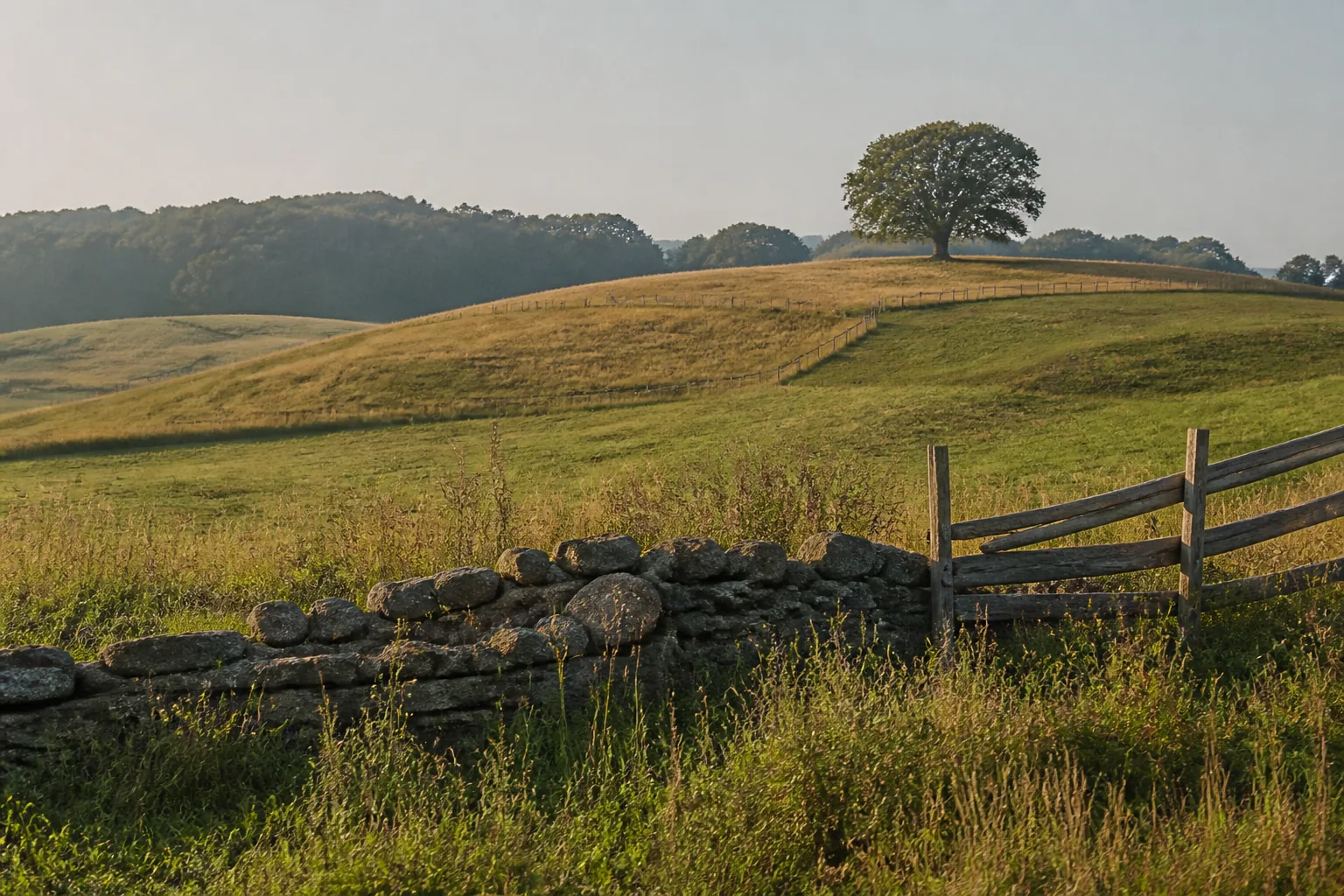
The battlefield’s shape did much of the work. Interior lines let one side move reserves across a position faster than the other could march around it.
Questions and answers
Why did the battle happen at Gettysburg?
Because ten roads met there, and both armies were manoeuvring blind. Neither commander chose the location; contact developed as forces converged on the junction, and by the time either headquarters understood the scale of what had begun, enough of each army was committed that disengaging was harder than fighting. It is the standard example of a major battle produced by the road network rather than by a decision.
What made the defensive position so strong?
Its shape. After the first day the defenders held a line of ridges and hills forming a fishhook a few miles long: high ground with clear fields of fire, interior lines allowing reserves to be moved from one threatened point to another quickly, and secure flanks anchored on hills. The attacker had to move around the outside of that curve, which meant longer marches and poorer coordination.
Was the third-day assault a mistake?
It is the most argued question in American military history and the honest answer is that the reasoning behind it was not absurd but the execution depended on conditions that did not hold. It required an artillery preparation to suppress the defence, which largely failed, and it committed infantry across roughly a mile of open ground against a prepared position with artillery on both flanks. The outcome was decisive and the losses were not recoverable.
Did Gettysburg end the war?
No, and the war continued for nearly two more years. It ended the last serious northern invasion and destroyed a large part of one army's offensive capability, and it coincided with a decisive result in the western theatre. Treating it as the war's turning point compresses two years of hard fighting elsewhere into a footnote.