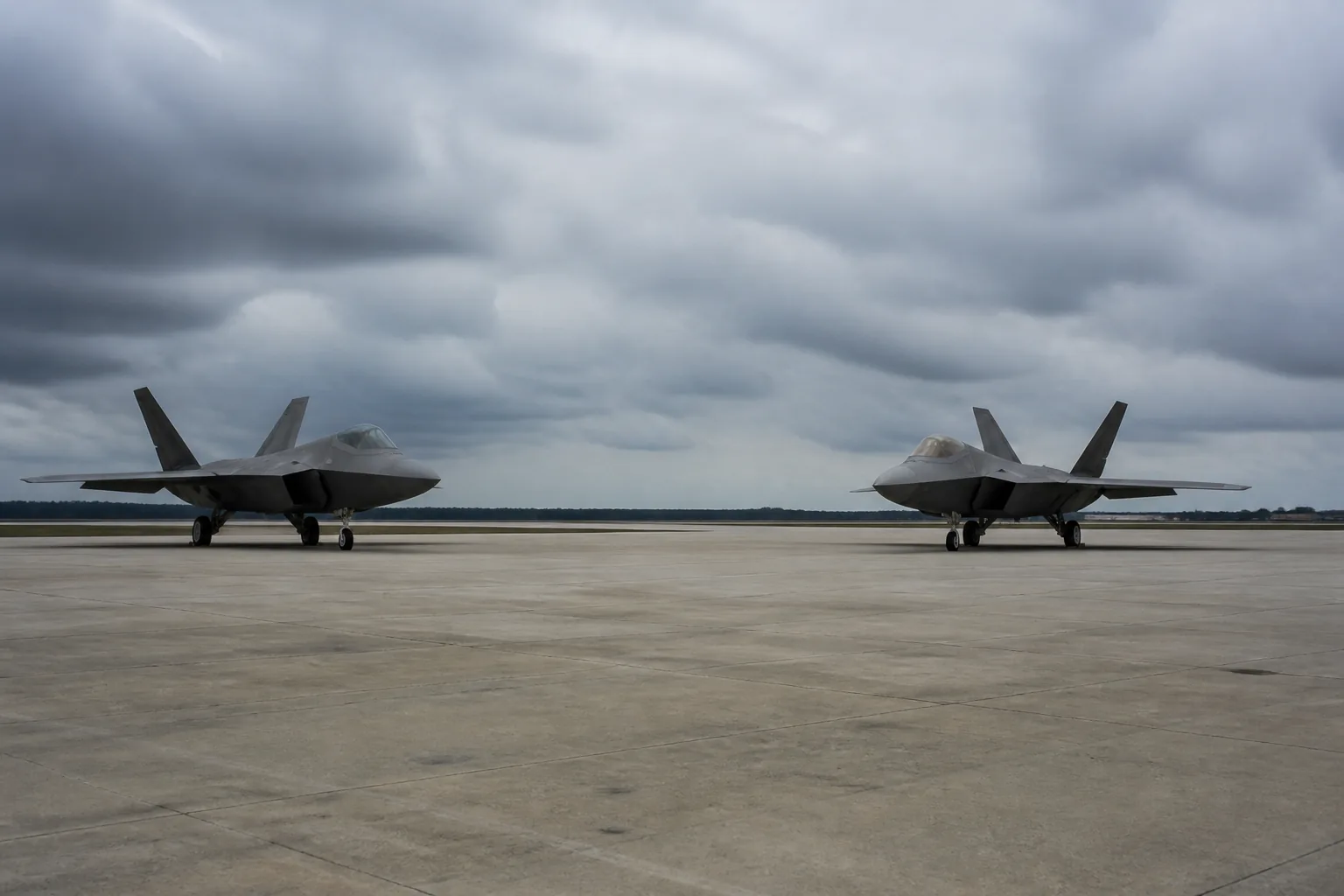
F-22 Raptor vs F-35 Lightning II
F-35 vs F-22: Two Aircraft Answering Two Different Questions

These two aircraft are compared constantly and the comparison is usually framed wrongly. They were built to answer different questions, roughly fifteen years apart, under different strategic assumptions. Treating them as rivals for the same job misses what each was actually for.
The F-22’s question
How do we guarantee air superiority against a peer air force?
The answer was an aircraft optimised almost entirely for that: extreme low observability designed in from the airframe up, two engines giving the thrust for sustained supersonic flight without afterburner, and kinematic performance prioritised over everything else. Ground attack was added later and was never the point.
It is an exceptional aircraft at the thing it was built for, and it was built for a threat that appeared to recede in the decade it entered service.
The F-35’s question
How do we replace many different aircraft, across three services and many allied air forces, affordably, and network them together?
That is a fundamentally different problem and it produced a fundamentally different aircraft. One engine, three variants (conventional, short take-off and vertical landing, and carrier) extensive sensor fusion presenting the pilot with a combined picture rather than separate displays, and designed from the outset to be exported and to share data with allied aircraft.
Every criticism and every strength follows from that requirement. The three-variant commonality that made the programme affordable in theory also made it enormously complex. The exportability that gives Western air forces a common platform also constrained the design. And the sensor and networking emphasis is precisely where it is strongest.
Why production numbers matter more than specifications
Fewer than 200 F-22s were built and the line is closed. More than a thousand F-35s have been delivered and production continues across many operators.
That difference dominates everything downstream. A small fleet with no production line cannot absorb attrition, cannot spread sustainment costs, and ages as a block. A large fleet with a global supply chain has the opposite properties, and a correspondingly large sustainment bill, which is where most of the F-35 criticism sits.
Twenty years on, the decision to end F-22 production early is widely regarded as costly, for reasons that had little to do with the aircraft: a strategic assessment in the 2000s that peer air combat was unlikely, and an export prohibition that removed the allied purchases which would have extended the line.
The comparison that is actually informative
Not which wins, but what each gave up.
The F-22 gave up numbers, multirole flexibility, exportability and affordable sustainment to get uncompromised air superiority performance.
The F-35 gave up peak kinematic performance and single-role optimisation to get scale, versatility, allied commonality and networked sensing.
Both trades were defensible against their requirements. Whether they were the right requirements is a question about strategic forecasting, and the record there (on both programmes) is mixed.
What decides real air combat
Worth stating, because it is what the popular version of this comparison leaves out. Outcomes are decided by detection ranges and who is seen first, by tanker availability and therefore by how long aircraft can stay, by airborne early warning and networked targeting, by munitions inventory, by maintenance and mission-capable rates, and by numbers.
Airframe performance matters and is far down that list. An aircraft that cannot be sustained at the required sortie rate loses to one that can, whatever its specifications say.
Side by side
| Criterion | F-22 Raptor | F-35 Lightning II |
|---|---|---|
| Primary requirement | Air superiority: defeat other fighters and hold airspace | Multirole: strike, air-to-air, reconnaissance, electronic warfare |
| Crew and engines | Single seat, two engines | Single seat, one engine |
| Variants | One, land-based only | Three: conventional, short take-off and vertical landing, carrier |
| Numbers built | Production ended after fewer than 200 aircraft | Well over a thousand delivered and continuing, across many operators |
| Design emphasis | Kinematic performance, supercruise, extreme low observability | Sensor fusion, networked data sharing, exportability |
| Export | Never exported; sale was prohibited | Operated by many allied air forces |
| Sustainment position | Small fleet, ageing, expensive per airframe to maintain | Large fleet with a global supply chain; sustainment cost has been the main criticism |
| Where each is going | No replacement in production; upgraded and eventually superseded | The backbone of Western tactical aviation for decades |
Questions and answers
Which one wins in a fight?
The question is less meaningful than it sounds. In a one-on-one air-to-air engagement the F-22's kinematics and air-superiority design favour it, and that is what it was built for. But air combat is not one-on-one: it is decided by who sees whom first, who is supported by tankers and airborne sensors, and how many aircraft are available. The F-35's sensor fusion and networking are advantages in that real setting.
Why did F-22 production stop so early?
A combination of unit cost, a strategic environment in the 2000s dominated by counter-insurgency and not peer air combat, and a decision that resources were better spent on the multirole programme. The consequence is a small, ageing fleet with no production line to reopen, widely regarded now as a costly decision.
Is one engine a weakness?
It is a trade. Two engines offer redundancy; one is cheaper to buy and maintain and reduces weight and complexity. Modern engine reliability makes single-engine designs acceptable where they were once questionable, and most tactical fighters produced today are single-engine for that reason.
Why is the F-35 criticised so heavily?
Mostly on cost and sustainment as opposed to capability: the cost per flying hour, spare-parts availability, mission-capable rates and the complexity of its logistics software have all drawn sustained criticism. Those are real problems about keeping a very large fleet flying, which is a different question from whether the aircraft is effective.
Could the F-22 have been exported?
No. Export was prohibited by law, partly to protect the technology. That decision contributed to the small production run, because allied purchases would have extended the line, and it is part of why the F-35 was designed from the start to be exportable.