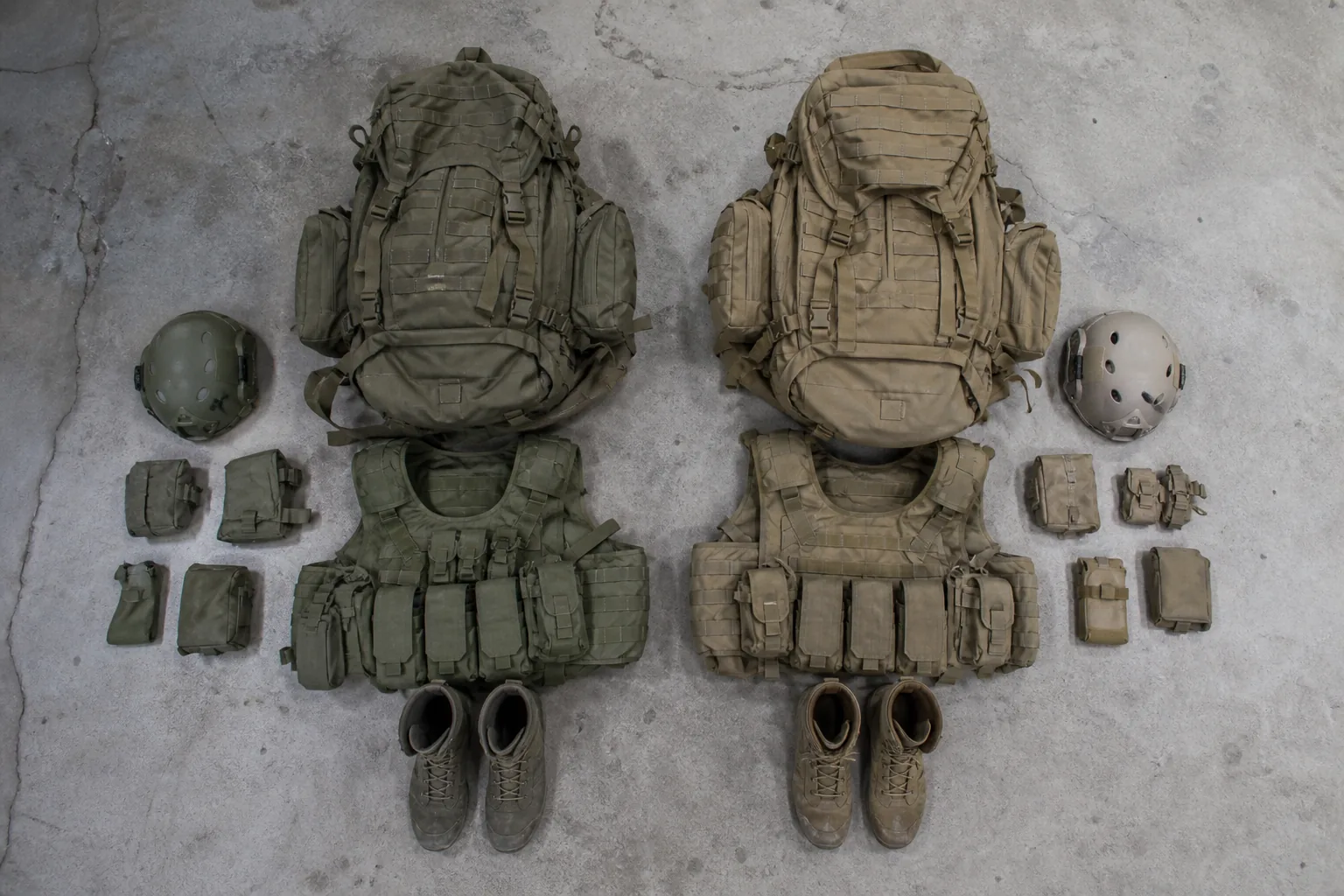
Army vs Marine Corps
Army vs Marines: Two Ground Forces Built for Different Problems

Both are ground combat forces and the comparison is genuinely useful, because they were built to solve different problems and almost every visible difference traces back to that.
The Army exists to fight and sustain land campaigns at scale. That requires mass, heavy equipment, theatre-level logistics and the ability to hold ground for years.
The Marine Corps exists to put a capable force ashore from the sea, fast, where the United States has no base and no standing permission. That requires being light enough to carry on ships, self-contained enough to operate on arrival, and organised around a task, not a domain.
The structural difference: task versus domain
The Army organises by domain and echelon: brigade combat teams inside divisions inside corps, with aviation, artillery and logistics as separate branches that support them.
The Marine Corps organises by task. A Marine air-ground task force puts ground combat, aviation, logistics and a command element under one commander. The commander does not request air support from another service; the aircraft are his. This scales from a unit of a few thousand to an expeditionary force of tens of thousands, and it is the single most distinctive thing about the Corps.
The trade is real. The MAGTF’s self-sufficiency comes at the cost of depth: it cannot sustain a long campaign the way an Army corps can, and it was never meant to.
Training and the identity question
Army initial training produces a soldier in a specific specialty: basic combat training, then job school, with combat arms specialties using a combined single-location course instead.
Marine recruit training is longer, happens at one of two depots, and is explicitly about transformation before instruction. Every Marine then completes combat training designed to make them employable as infantry, whatever their eventual field, before going to their job school.
That sequence encodes a doctrinal principle (every Marine a rifleman), which the Army does not hold. The reasoning is that an expeditionary force ashore has no spare people. It is a genuine difference, not a slogan, and it shows up in how the two services distribute combat training across their forces.
The recent divergence
The Corps has spent recent years deliberately restructuring away from the equipment set it used in Iraq and Afghanistan — divesting heavy armour and some artillery in favour of lighter, dispersed units with long-range anti-ship and air-defence capability, intended for contested maritime terrain.
This is contested inside and outside the service. Critics argue the Corps is discarding general-purpose capability that has repeatedly been needed on short notice; advocates argue a second land army is not what the country lacks. Both positions rest on predictions about the next conflict, which is why neither can be settled now.
The relevant point for this comparison is that the two services are becoming more different rather than less.
What actually matters if you are choosing
The job you want, more than anything else. The Army’s size gives it far more specialties, including many with no combat role and direct civilian equivalents. The Corps has fewer, and a greater share of its force is oriented toward fighting.
After that: whether you want organic aviation and a task-force structure or the depth and lateral options of a large institution, and whether ship-based forward deployment or longer land rotations suits your life better.
Culture is real and is the thing people talk about most, and it is also the thing you can least usefully evaluate from outside.
Side by side
| Criterion | Army | Marine Corps |
|---|---|---|
| Core purpose | Sustained land campaigns, at scale, with the logistics to hold ground | Arriving from the sea, quickly, without a host nation's permission |
| Size | By far the largest service | Roughly a fifth of the Army's strength |
| How it organises | By domain: brigade combat teams inside divisions and corps | By task: air-ground task forces with organic aviation and logistics |
| Heavy capability | Armoured formations, theatre-level artillery, engineering and sustainment | Deliberately lighter; heavy armour divested in recent restructuring |
| Aviation | Rotary-wing owned by the Army; fixed-wing support from the Air Force | Owns fixed-wing, rotary-wing and tiltrotor as part of the task force |
| Recruit training | Basic combat training at several posts, then job school | Longer recruit training at one of two depots, then combat training, then job school |
| Everyone a rifleman | Not a doctrinal principle; specialties vary widely in combat training | Doctrinal: every Marine completes infantry-capable combat training |
| Career breadth | Very wide range of specialties, including many with no combat role | Narrower; more of the force is oriented toward the fight |
Questions and answers
Is Marine training harder than Army training?
Marine recruit training is longer and organised around a single identity outcome before any job training, and it is widely regarded as more physically and psychologically demanding. Whether that makes it harder overall depends on the comparison: Army combat arms One Station Unit Training is a long, hard course too. The honest answer is that they are optimised for different things: the Corps for transformation, the Army for producing a specific specialty efficiently.
Which one deploys more?
Marine expeditionary units are forward-deployed aboard ships on a routine rotation, so a Marine may spend long periods at sea without a war happening. Army units deploy on longer, less frequent rotations tied to specific commitments. Total time away can be similar; the pattern is very different.
Do Marines have better career prospects?
Not systematically, and the smaller size cuts both ways. Fewer specialties means less choice; a smaller officer corps means fewer senior positions relative to applicants. The Army's size gives more lateral options and more paths to a technical career.
Which is better if I want a civilian-transferable skill?
The Army, mainly because it has more specialties that exist in the civilian economy: medical, IT, logistics, legal, engineering at scale. The Corps has those roles too, in smaller numbers, and a greater share of its force is in combat arms where the transfer is indirect.
Are Marines part of the Navy?
The Marine Corps is a separate armed service within the Department of the Navy. It has its own commandant, doctrine and budget, and depends on the Navy for the ships that carry it and much of its medical support.